In the realm of industrial automation, the ability to detect the presence or absence of metallic objects without physical contact is fundamental. This critical task is reliably performed by inductive proximity sensors. These robust, non-contact devices are ubiquitous on factory floors, silently orchestrating processes in packaging, machining, assembly, and material handling. Their core function is elegantly simple: to sense ferrous and non-ferrous metals through the principle of electromagnetic induction, providing a precise electrical signal to a control system.
The working principle of an inductive proximity sensor is rooted in physics. At its heart lies an oscillator circuit that generates a high-frequency electromagnetic field. This field radiates from the sensor's active face, typically made of a ferrite core surrounded by a coil. When a metallic object enters this oscillating field, eddy currents are induced on the surface of the target. These eddy currents draw energy from the oscillator, causing its amplitude to decrease. An evaluation circuit within the sensor continuously monitors this amplitude. Once the energy loss reaches a predetermined threshold—corresponding to the object being within the specified sensing range—the circuit triggers a state change in the sensor's output. This output, either a solid-state switch (PNP or NPN) or a relay, then signals the connected controller, such as a PLC, that an object has been detected.
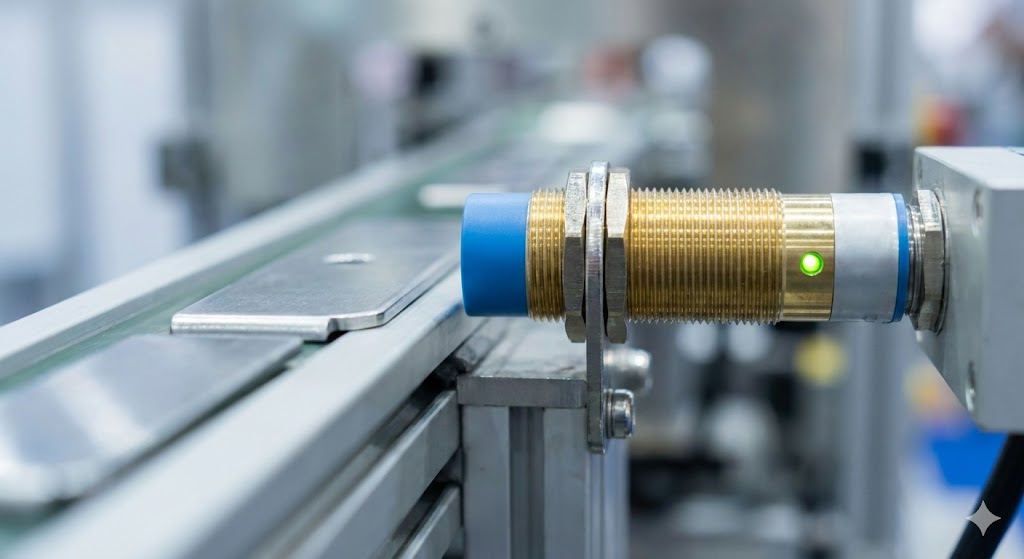
This technology offers distinct advantages. First and foremost is its non-contact nature, which eliminates mechanical wear and tear, ensuring a long operational life even in demanding, high-cycle applications. Inductive sensors are exceptionally reliable, immune to environmental factors like dust, dirt, oil, and moisture (given appropriate IP ratings), making them ideal for harsh industrial environments. They provide fast response times, capable of detecting objects at speeds unsuitable for mechanical limit switches. Furthermore, they are self-contained, requiring no separate emitter and receiver, which simplifies installation and alignment.

The applications are vast and varied. Common uses include part detection on conveyor lines (confirming a component is present before a robotic arm picks it up), position sensing of machine tool slides or cylinders, end-of-travel detection, and counting metallic objects like cans or bolts. They are essential in rotary speed monitoring by detecting gear teeth or keyways. In metalworking, they verify the open or closed state of clamps and fixtures. Their robustness also makes them perfect for use in automated welding systems and heavy machinery.
Selecting the right inductive sensor requires careful consideration of several parameters. The sensing distance, or nominal range, is crucial and is specified for a standard target (usually mild steel). This range is reduced for non-ferrous metals like aluminum or copper. The target material and size must be considered; a target should generally be at least as large as the sensor's face. Output type is key: PNP (sourcing) and NPN (sinking) transistors are standard, with the choice depending on the control system's input card. Connection style options include pre-wired cables or quick-disconnect connectors. The housing material (often nickel-plated brass or stainless steel) and Ingress Protection (IP) rating must be suitable for the environment, especially if exposed to coolants, washdowns, or physical impact. Finally, special designs like cylindrical threaded barrels, rectangular block styles, or ring-shaped sensors for detecting small parts offer solutions for specific mounting challenges.
While incredibly versatile, these sensors have inherent limitations. They can only detect metallic objects. The effective sensing distance can be influenced by the specific type of metal. They also require a minimum distance between multiple sensors to prevent mutual interference, known as flanking. Understanding these constraints is part of effective system design.

In conclusion, the inductive proximity sensor is a cornerstone of modern industrial control. Its durable, contactless operation based on electromagnetic induction provides a reliable and maintenance-free solution for countless detection tasks involving metals. By understanding its operating principle, strengths, and selection criteria, engineers and technicians can effectively integrate these vital components to enhance the efficiency, safety, and reliability of automated systems.