High-range laser sensors represent a pivotal advancement in non-contact measurement technology, offering unparalleled accuracy and reliability across diverse industrial sectors. These devices utilize laser triangulation or time-of-flight principles to measure distances, dimensions, and profiles with micron-level precision over extended ranges, often exceeding several meters. Unlike traditional contact-based sensors, laser sensors eliminate mechanical wear, reduce maintenance costs, and enable high-speed data acquisition, making them indispensable in automation, aerospace, automotive manufacturing, and civil engineering.
The core technology behind high-range laser sensors involves emitting a focused laser beam toward a target surface. The reflected light is captured by a high-resolution receiver, and sophisticated algorithms calculate the distance based on the beam's angle or flight time. Modern sensors incorporate adaptive optics and signal processing enhancements to compensate for environmental variables such as ambient light interference, surface reflectivity variations, and temperature fluctuations. For instance, in automotive assembly lines, these sensors verify component alignment and weld seam quality in real-time, ensuring compliance with stringent safety standards. Similarly, in aerospace, they facilitate precise inspection of turbine blades and fuselage contours, minimizing human error and enhancing production efficiency.
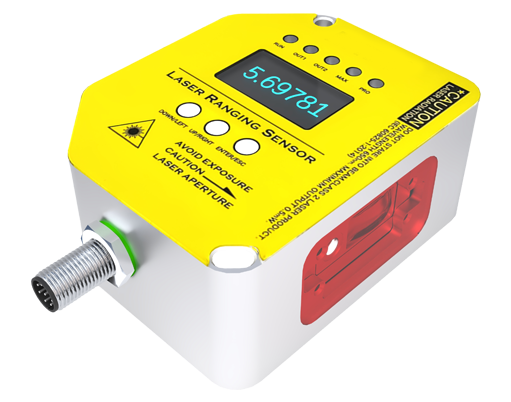
Key advantages of high-range laser sensors include their ability to operate in harsh conditions—withstanding vibrations, dust, and extreme temperatures—while maintaining measurement stability. Integration with IoT platforms and Industry 4.0 systems allows for predictive analytics, where sensor data monitors equipment degradation and triggers preemptive maintenance alerts. A case study in the energy sector demonstrates their use in monitoring structural deformations of wind turbine blades over distances up to 50 meters, enabling early detection of fatigue cracks and optimizing operational lifespan.
Despite their robustness, challenges persist, such as handling highly reflective or transparent surfaces, which can scatter laser signals. Innovations like multi-echo technology and wavelength diversification are addressing these limitations, expanding applicability to industries like pharmaceuticals and food processing. As sensor miniaturization progresses, portable high-range laser devices are revolutionizing field surveys in construction and archaeology, providing 3D mapping capabilities without physical contact.

Future trends point toward enhanced AI-driven calibration, where sensors self-adjust based on real-time environmental feedback, and the integration of LiDAR for autonomous robotics. With global demand rising for precision manufacturing and smart infrastructure, high-range laser sensors are set to become even more critical, driving efficiency, safety, and innovation. Industry professionals must stay abreast of these developments to leverage their full potential, ensuring competitive advantage in an increasingly automated world.