Proximity switch sensors are essential components in modern industrial automation, widely used for object detection, position sensing, and machine safety. Unlike mechanical switches, proximity sensors operate without physical contact, offering high reliability and long service life. This article provides a detailed explanation of the working principle of proximity switch sensors, supported by clear diagrams to enhance understanding.
Proximity sensors detect the presence or absence of an object within a specific range using electromagnetic fields, light, or sound. The most common types include inductive, capacitive, and photoelectric sensors. Inductive proximity sensors are designed to detect metallic objects. They consist of a coil, an oscillator, a detection circuit, and an output circuit. When an AC current passes through the coil, it generates an alternating magnetic field. If a metallic object enters this field, eddy currents are induced in the object, causing a change in the coil's impedance. The sensor's detection circuit monitors this change and triggers the output circuit to switch states, indicating the object's presence.
Capacitive proximity sensors can detect both metallic and non-metallic objects, such as liquids, plastics, or wood. These sensors utilize a capacitor formed by the sensor's surface and the target object. An oscillator circuit generates an electric field between the sensor's electrodes. When an object enters this field, the capacitance changes, altering the oscillator's amplitude. The sensor's circuit detects this variation and activates the output. This makes capacitive sensors versatile for various applications, including level detection and material handling.
Photoelectric proximity sensors use light beams to detect objects. They comprise a light emitter (usually an LED) and a receiver. When an object interrupts or reflects the light beam, the receiver detects the change in light intensity, and the sensor outputs a signal. Photoelectric sensors are ideal for long-range detection and can identify objects regardless of material composition.
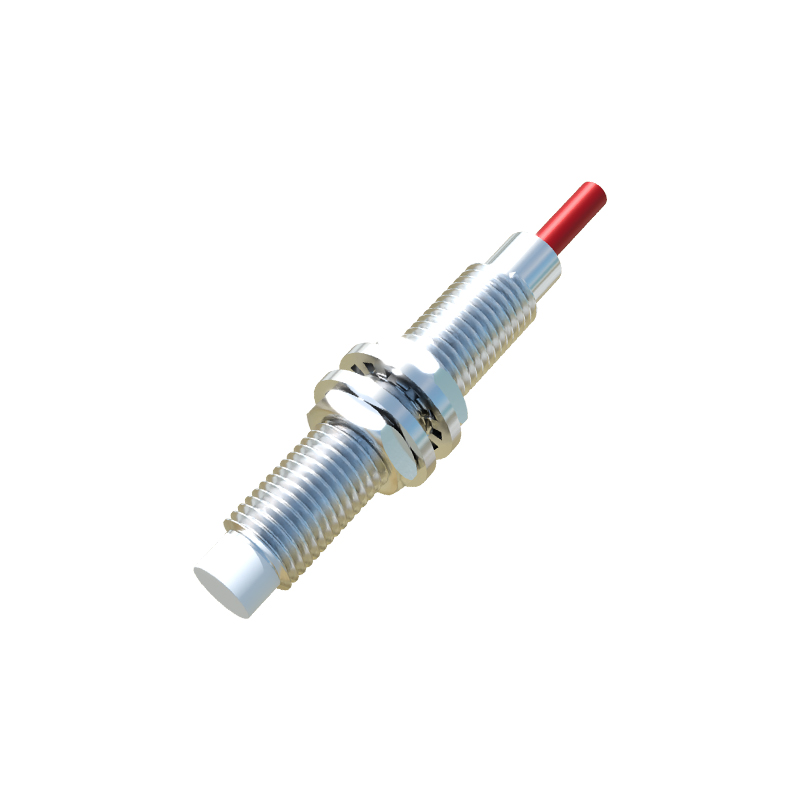
The working principle diagram of an inductive proximity sensor typically includes the following components: power supply, oscillator coil, Schmitt trigger, and output transistor. In the diagram, the oscillator generates a high-frequency magnetic field. When a metal target approaches, eddy currents reduce the oscillation amplitude. The Schmitt trigger processes this signal, turning the output transistor on or off. This non-contact operation minimizes wear and tear, making inductive sensors suitable for harsh environments with dust, moisture, or vibrations.
For capacitive sensors, the diagram highlights the electrode plates, oscillator, and comparator circuit. The oscillator's frequency shifts as capacitance changes, and the comparator converts this into a digital signal. Photoelectric sensor diagrams illustrate the emitter, receiver, and modulation circuit to distinguish between ambient light and the sensor's signal, ensuring accurate detection.
Key advantages of proximity sensors include fast response times, high switching frequency, and resistance to environmental factors. They are commonly applied in conveyor systems, robotic arms, automotive assembly lines, and safety interlocks. When selecting a proximity sensor, consider factors like sensing distance, target material, environmental conditions, and output type (e.g., NPN or PNP).
In summary, proximity switch sensors rely on electromagnetic or optical principles to detect objects without physical contact. Diagrams help visualize how components like coils, oscillators, and circuits interact to achieve reliable sensing. Understanding these principles enables engineers to optimize sensor selection and integration for industrial automation, enhancing efficiency and safety. Regular maintenance, such as cleaning sensor surfaces and checking wiring, ensures long-term performance. As technology advances, smart sensors with IoT connectivity are emerging, offering real-time monitoring and diagnostics for predictive maintenance.