In industrial automation, robotics, and consumer electronics, proximity sensors play a critical role in detecting the presence or absence of objects without physical contact. Among their many performance parameters, response frequency stands out as a crucial determinant of system speed, accuracy, and overall efficiency. This metric, often measured in Hertz (Hz), defines how many detection cycles a sensor can complete per second. Understanding and optimizing response frequency is essential for engineers and designers working on high-speed applications.
The response frequency of a proximity sensor is fundamentally limited by its underlying sensing technology. Inductive sensors, which detect metallic objects, typically offer very high response frequencies, often ranging from 500 Hz to 5 kHz, with some high-end models exceeding 10 kHz. Their operation relies on the change in an oscillating electromagnetic field, a process that can be very rapid. Capacitive sensors, used for detecting both metallic and non-metallic materials, generally have slightly lower response frequencies due to the time required for charge and discharge cycles, commonly operating between 10 Hz and 500 Hz. Photoelectric sensors, which use light beams, can achieve exceptionally high frequencies, from 500 Hz to 50 kHz or more, as the primary limitation becomes the speed of the light emitter and receiver circuitry rather than the physical detection principle.
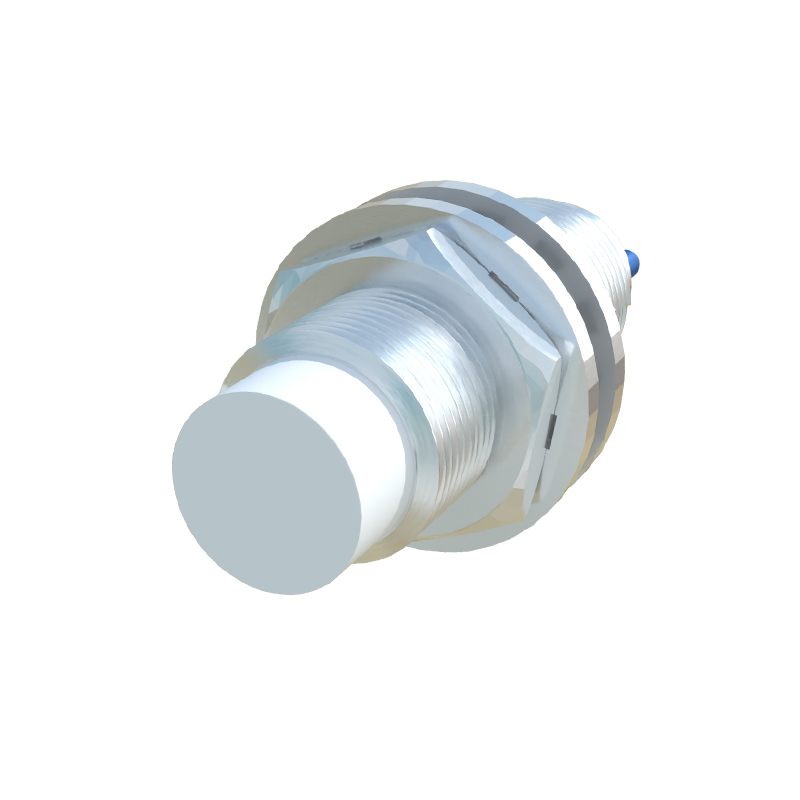
Several key factors directly influence the achievable response frequency. The first is the sensor's internal oscillator and signal processing circuit design. Higher-quality components and optimized filtering algorithms can significantly reduce processing latency. The second factor is the target object itself. For inductive sensors, the size, material, and distance of the metal target (the sensing distance) affect the strength and speed of the eddy current generation. A larger, closer target typically produces a stronger, faster signal. The third major factor is the output configuration. Sensors with a digital NPN or PNP transistor output can switch much faster than those with an analog current output (e.g., 4-20mA), which requires time for the signal to settle. Finally, environmental conditions like temperature extremes or electrical noise can force the sensor to employ more aggressive filtering, thereby reducing its effective response speed to maintain stability.
The consequences of an inadequate response frequency are tangible in real-world applications. In a high-speed packaging line, a sensor with a 100 Hz response frequency can theoretically check an object every 10 milliseconds. If products pass by at a rate of 200 items per second, the sensor will miss half of them, leading to counting errors, improper sorting, or machine jams. In robotic pick-and-place operations, a slow sensor can create a bottleneck, limiting the robot's maximum cycle time and reducing throughput. Conversely, specifying a sensor with an excessively high response frequency for a slow-moving application is an unnecessary cost that offers no performance benefit.
Optimizing system performance requires careful matching of the sensor's response frequency to the application's demands. The calculation is straightforward: Required Frequency (Hz) = Object Speed (units/second) / Allowed Error Margin. For instance, to detect 500 bottles per minute on a conveyor with a requirement of zero misses, the minimum frequency needed is 500/60 ≈ 8.3 Hz. Engineers should then select a sensor with a rated frequency at least 1.5 to 2 times this value to provide a safety margin for signal variations and acceleration/deceleration phases. Other optimization strategies include minimizing the sensing distance to the practical minimum, as a shorter distance often allows for a faster response. Using a target material and size that optimally interacts with the sensor (e.g., mild steel for inductive sensors) also improves speed. Ensuring stable power supply voltage and implementing proper shielding against electromagnetic interference (EMI) prevents false triggers and allows the sensor to operate at its maximum rated frequency without needing slowdown for noise immunity.
When integrating high-frequency sensors, wiring and controller compatibility become paramount. Fast-switching outputs demand low-capacitance cables to prevent signal degradation. The programmable logic controller (PLC) or counter receiving the signal must have an input circuit capable of registering the high-speed pulses. Many modern sensors feature adjustable response delay or filtering settings, allowing technicians to fine-tune the device, trading off a small amount of speed for increased noise immunity in electrically noisy environments like those near motor drives or welders.
In conclusion, the response frequency is not just a number on a datasheet but a core characteristic that defines the realm of possibility for a sensing application. By thoroughly analyzing the required detection speed, understanding the limitations imposed by sensor technology and target characteristics, and following sound electrical installation practices, engineers can ensure their automated systems are both fast and reliable. The ongoing advancement in semiconductor technology continues to push the boundaries, enabling proximity sensors with higher frequencies and smarter adaptive filtering, paving the way for even faster and more precise industrial automation.
SEO描述