Pin-type proximity switch sensors with integrated cables represent a critical component in modern industrial automation and control systems. These sensors are designed to detect the presence or absence of metallic objects without physical contact, relying on electromagnetic fields. The "pin-type" designation refers to their compact, cylindrical form factor, typically with an M5, M8, or M12 threaded barrel, allowing for easy installation in tight spaces. The integrated cable, often a PVC or PUR sheathed 2-meter or 5-meter wire, provides a robust and reliable connection to the control unit, eliminating the need for separate connector assemblies and reducing potential failure points.
The operational principle is based on Eddy current loss. The sensor's oscillator circuit generates a high-frequency electromagnetic field at its active face. When a metallic target (such as steel, aluminum, or brass) enters this field, Eddy currents are induced in the target, causing a change in the oscillation amplitude. This change is detected by the sensor's threshold circuit, which subsequently switches the output state. The two primary output types are NPN (sinking) and PNP (sourcing), with both normally open (NO) and normally closed (NC) configurations available to suit different PLC (Programmable Logic Controller) input card requirements.
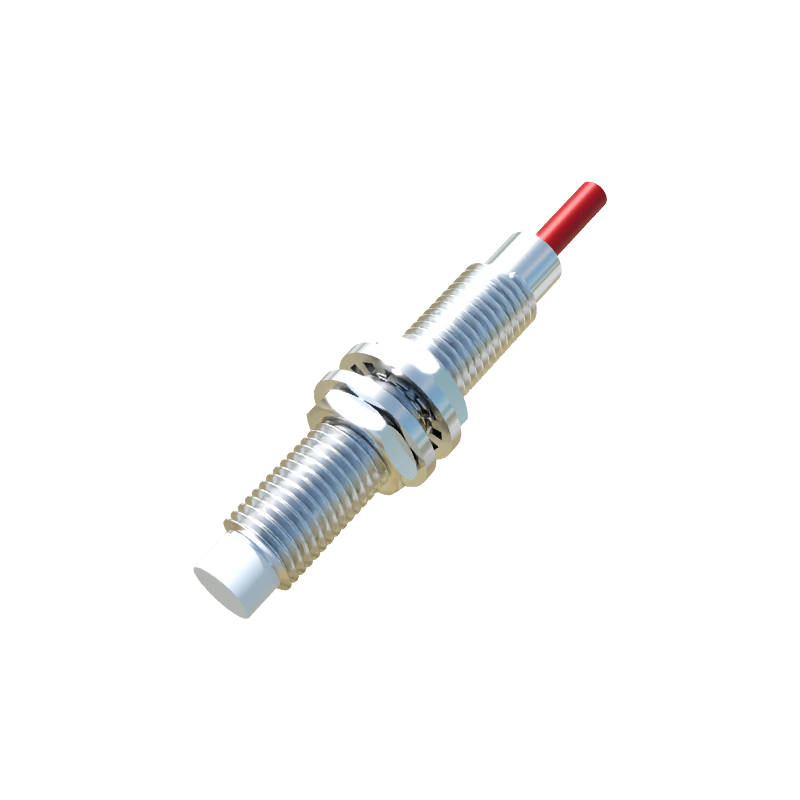
Key advantages of pin-type cabled proximity sensors include their high switching frequency, often exceeding 1 kHz, enabling precise detection in high-speed applications like packaging or assembly lines. Their non-contact nature ensures virtually infinite mechanical life and no wear on either the sensor or the target. The sealed construction, commonly meeting IP67 or IP68 ratings, provides excellent resistance to dust, coolants, and oils, making them ideal for harsh manufacturing environments. The pre-attached cable simplifies wiring but requires careful consideration of cable routing to prevent snagging or damage; strain relief at the sensor entry point is crucial.

When selecting a pin-type proximity sensor, engineers must consider several parameters. Sensing distance, specified for a standard mild steel target, is critical; for an M8 sensor, this is typically 1.5 to 2 mm. Factors like target material, size, and temperature influence the effective sensing range. Temperature range, usually from -25°C to +70°C, must align with the operating environment. The housing material, often nickel-plated brass or stainless steel, determines corrosion resistance. Electrical specifications, including operating voltage (commonly 10-30V DC) and current rating, must match the control system.
Installation and application best practices are paramount for reliable operation. Maintaining the specified lateral and axial clearance from metal mounting surfaces prevents false triggering due to the sensor's own field. The target should approach the sensor face perpendicularly for optimal performance. Common applications include position verification of machine parts, end-of-travel detection on cylinders, rotary encoder synchronization, and piece counting on conveyor systems. In robotic cells, they provide precise feedback for gripper positioning.
Troubleshooting typically involves checking the power supply, verifying the target is within range and of correct material, and inspecting the cable for damage. LED indicators on most sensors provide immediate status feedback. Compared to connector-type versions, the cabled variant offers a more cost-effective and vibration-resistant solution for fixed installations, though it may be less convenient for frequent replacement.
Future trends point towards miniaturization, with even smaller form factors like M3 sensors emerging, and the integration of IO-Link communication for advanced diagnostics, parameter setting, and process data reporting. This digital capability transforms simple sensors into intelligent devices within Industry 4.0 frameworks. In conclusion, the pin-type cabled proximity sensor remains a fundamental, reliable workhorse for industrial sensing. Its correct selection, installation, and integration are essential for building resilient and efficient automated systems, ensuring precise control and maximizing uptime across countless manufacturing and processing operations.