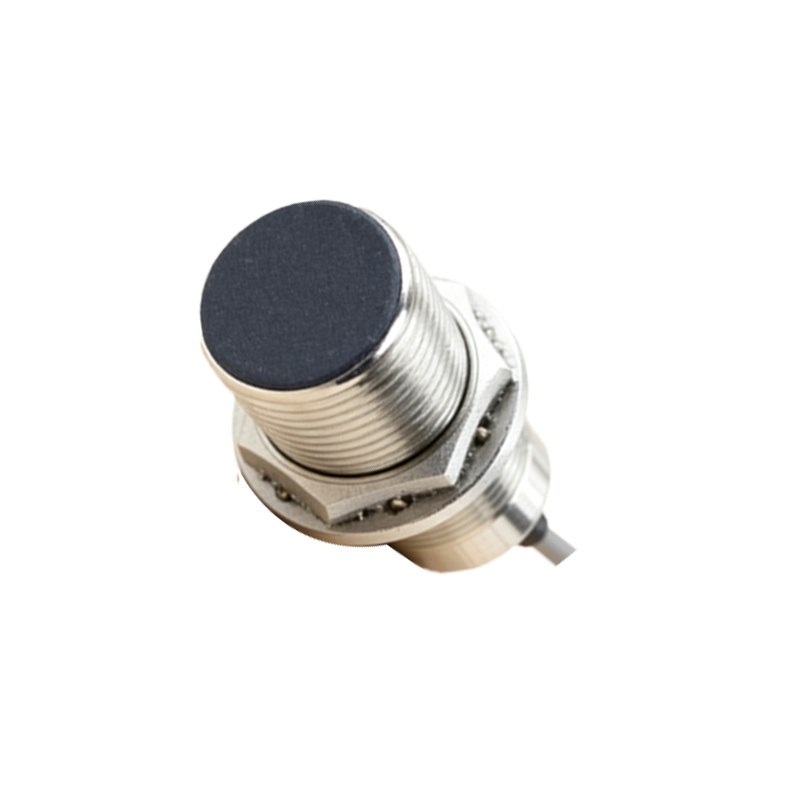
Inductive proximity sensors are fundamental components in modern industrial automation, offering non-contact detection of metallic objects. These sensors operate on the principle of electromagnetic induction, where an oscillator generates a high-frequency electromagnetic field from a coil at the active face. When a metallic target enters this field, eddy currents are induced, causing a change in the oscillation amplitude. This change is detected by the sensor's circuitry, triggering a solid-state output signal. One of the most significant features is their robustness in harsh environments. Encased typically in nickel-plated brass, stainless steel, or PBT plastic housings, they exhibit high resistance to dust, moisture, oils, and coolants, making them ideal for machine tools, material handling, and automotive assembly lines. Unlike optical sensors, they are immune to ambient light interference and common contaminants. Another key characteristic is their switching frequency and sensing range. Standard inductive sensors offer switching frequencies up to several kilohertz, enabling detection of fast-moving objects on high-speed production lines. The sensing range, however, is relatively short and is precisely defined by the sensor's diameter and the target material. For instance, a standard 18mm diameter sensor might have a nominal sensing distance of 5mm for mild steel (Fe360). It is crucial to note that the sensing distance reduces for non-ferrous metals like aluminum or copper, often requiring a correction factor. This material dependency is a critical consideration during selection. Furthermore, these sensors are praised for their exceptional repeat accuracy, often within microns, ensuring consistent and reliable operation in precision positioning tasks. They are available in various output configurations, including NPN, PNP, analog (4-20mA, 0-10V), and IO-Link versions for smart factory integration. The self-contained, solid-state design with no moving parts translates to virtually infinite mechanical life and minimal maintenance. A notable feature is the embedded protection against short-circuit, overload, and reverse polarity, enhancing system reliability. When selecting an inductive proximity sensor, engineers must evaluate factors like housing style (cylindrical, rectangular, or ring-shaped), mounting method (flush or non-flush), temperature rating, and connection type (cable or connector). Flush-mounted variants allow installation in metal without loss of sensing range. Modern advancements include factor-1 sensors capable of detecting all metals at the same range, and models with increased switching distances. In summary, inductive proximity sensors provide a durable, precise, and cost-effective solution for metallic object detection, forming the backbone of countless automated systems where reliability under tough conditions is paramount. Their simplicity, longevity, and adaptability continue to secure their indispensable role in industrial sensing technology.