Laser displacement sensors, also known as laser triangulation sensors, are non-contact measurement devices widely used in industrial automation, quality control, and research. Their core principle is based on the geometric method of triangulation, enabling precise measurement of distance, thickness, vibration, and deformation with high speed and accuracy.
The fundamental operation involves three key components: a laser diode, a focusing lens, and a position-sensitive detector (PSD), typically a CMOS or CCD linear array. The laser diode emits a focused beam of visible red or infrared light onto the target surface. The diffusely reflected light from this point is then collected by the receiver lens and projected onto the PSD. The angle at which this reflected light enters the lens changes depending on the distance to the target. This angular shift causes the position of the light spot on the PSD to move linearly.
By precisely calculating this positional shift on the detector, the sensor's internal processor determines the exact distance to the target using trigonometric formulas. The basic triangulation geometry forms a triangle between the laser source point, the illuminated point on the target, and the point where the reflected light strikes the detector. A change in the target's position alters the angles within this triangle, resulting in a proportional movement of the light spot on the PSD. Sophisticated algorithms convert this analog positional data into a highly accurate digital distance value.
Several critical factors influence sensor performance and selection. The type of target surface is paramount; rough, matte surfaces provide ideal diffuse reflection, while shiny or transparent materials can cause specular reflection or beam penetration, leading to measurement errors. Specialized models with adjustable optics or coaxial designs mitigate these issues. Other parameters include measuring range, stand-off distance, spot size, linearity, resolution (often in micrometers), and sampling speed. High-end sensors can achieve sub-micron resolution and kHz-level sampling rates, suitable for dynamic vibration analysis.
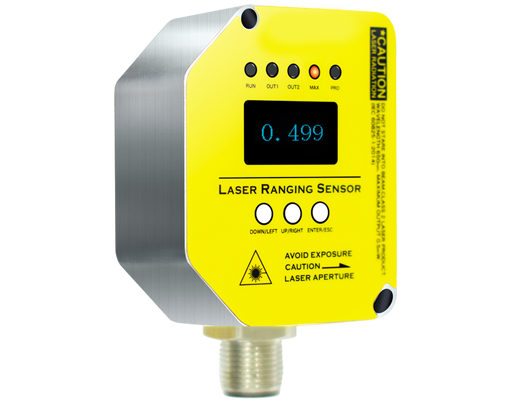
Applications are vast and integral to modern manufacturing. In automotive assembly, these sensors verify panel gaps and flushness. In electronics, they measure component coplanarity and solder paste thickness. In rolling mills, they monitor sheet metal thickness in real-time. They are also deployed for vibration monitoring of rotating machinery, wafer warpage inspection in semiconductor fabrication, and robotic guidance for precise pick-and-place operations. Their non-contact nature prevents part damage or wear, making them ideal for delicate materials or high-speed production lines.
Recent advancements include the integration of blue laser technology. Blue lasers, with their shorter wavelength, scatter more effectively on rough or organic surfaces (like rubber, untreated metals, or textiles) compared to traditional red lasers, providing more stable and reliable measurements on challenging surfaces. Furthermore, developments in multi-point and profile sensors, which use laser lines instead of single points, enable simultaneous 2D and 3D contour measurement for complex inspections.
In conclusion, laser displacement sensors are indispensable tools for precision metrology. Their operation, rooted in simple triangulation physics, is enhanced by advanced electronics and optics to deliver robust, high-performance solutions for demanding industrial environments. Understanding the principle of triangulation, along with key application considerations, allows engineers to effectively select and deploy these sensors to enhance quality, efficiency, and automation.