Laser distance sensors, also known as laser rangefinders or LiDAR sensors in specific configurations, are pivotal components in modern industrial automation, robotics, and surveying. At their core, these sophisticated devices sense and measure the physical distance between the sensor itself and a target object or surface. But to say they merely "sense distance" is an oversimplification. Fundamentally, they sense the time or phase shift of light. By emitting a focused, coherent beam of laser light and analyzing the properties of the reflected signal, they extract precise spatial data.
The primary principle behind most industrial laser distance sensors is either Time-of-Flight (ToF) or triangulation. In the Time-of-Flight method, the sensor precisely measures the time interval between the emission of a laser pulse and the detection of its reflection. Since the speed of light is a known constant, the distance can be calculated using the formula: Distance = (Speed of Light × Time of Flight) / 2. This method is excellent for long-range measurements, from several meters to kilometers, and is commonly used in construction, forestry, and autonomous vehicle navigation systems. The sensor here is essentially sensing the minute time delay of photons.
Conversely, for high-precision, short-range applications (often from millimeters to a few meters), the laser triangulation principle is employed. In this setup, a laser diode projects a visible or invisible spot onto the target. A receiving lens, positioned at a known angle offset from the emitter, focuses the reflected spot onto a position-sensitive detector, typically a CCD or CMOS array. As the target distance changes, the position of the light spot on the detector shifts linearly. By sensing this precise positional shift of the light spot on the detector, the sensor's internal processor calculates the distance via trigonometric relationships. This method provides exceptional accuracy, often in the micron range, making it indispensable in manufacturing for thickness gauging, weld seam tracking, and part positioning.
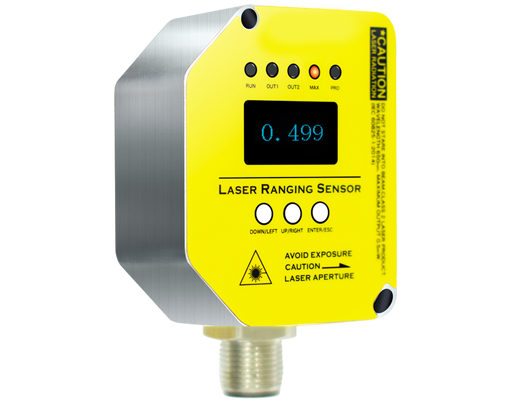
Therefore, what the sensor ultimately provides—a digital or analog output corresponding to distance—is the result of processing a more fundamental sensed quantity: light's time in flight or its geometric displacement. Advanced sensors go further, sensing additional parameters derived from the light signal. For instance, some sensors can evaluate the intensity of the return signal, which provides information about the target's surface reflectivity, color, or even cleanliness. A weak return signal might indicate a dark, absorbent surface or the presence of dust, triggering a maintenance alert in an automated system.
Furthermore, in the realm of 2D and 3D LiDAR, the sensor senses not just a single point distance but millions of points per second, creating a detailed "point cloud" map of the environment. Here, it senses spatial profiles and contours. By scanning the laser beam rapidly across a plane or area, these sensors can detect the presence, shape, and orientation of objects. This capability is crucial for robotic bin-picking, volume measurement of bulk materials, and collision avoidance in automated guided vehicles (AGVs).
The choice of laser wavelength, typically red visible lasers or infrared lasers, also defines what the sensor can optimally sense. Infrared lasers are less affected by ambient visible light and are often used for longer ranges or in challenging industrial environments. Visible red lasers are preferred for alignment and setup tasks where the operator needs to see the measurement point.

In practical industrial applications, a laser distance sensor is rarely just sensing distance in isolation. It is integrated into a control system where its data becomes part of a larger decision-making process. For example, on a conveyor belt, it might sense the height of packages to direct them to the correct sorting chute. In a storage rack, it might sense the fill level of a silo by measuring the distance to the material surface. In robotic assembly, it senses the precise position of a component to guide the manipulator's gripper.
Environmental factors are critical to what the sensor can reliably sense. The target's surface properties—such as gloss, color, texture, and material—directly impact the strength and quality of the reflection. Highly reflective or transparent surfaces can pose challenges, often requiring special sensors with background suppression or diffuse reflection technology. Ambient conditions like dust, steam, or extreme temperatures must also be considered, as they can attenuate the laser beam or cause erroneous readings. Modern sensors incorporate sophisticated algorithms and hardware designs to compensate for these variables, ensuring stable and reliable measurements.

In conclusion, a laser distance sensor is a versatile tool that senses the interaction between coherent light and a target. Its primary output is precise, non-contact distance measurement, derived from sensing the time delay or angular displacement of reflected laser light. Beyond simple distance, it can indirectly sense surface properties, profile shapes, and volumetric presence, providing the essential eyes for automated systems. As Industry 4.0 advances, the role of these sensors in sensing the physical world and feeding data to digital twins will only become more profound, driving efficiency, quality, and safety across countless industries.