In the realm of industrial automation and machine safety, the reliability and precision of sensing components are paramount. Among the diverse array of proximity sensors available, the LM30-3015NA stands out as a robust and widely utilized inductive proximity switch. This article provides a comprehensive technical analysis and application guide for this specific sensor model, delving into its operating principles, key specifications, and best practices for deployment in demanding industrial environments.
At its core, the LM30-3015NA is a cylindrical, non-contact inductive proximity sensor. Its fundamental operating principle is based on electromagnetic induction. The sensor incorporates an oscillator circuit that generates a high-frequency electromagnetic field at its active face. When a metallic object (the "target") enters this detection field, eddy currents are induced within the target. This causes a change in the oscillation amplitude within the sensor's internal circuit. A subsequent evaluation circuit detects this change and triggers a solid-state switching output, typically an NPN normally-open (NO) configuration as denoted by the "NA" suffix. This entire process occurs without any physical contact, ensuring long operational life and minimal wear.
The model designation "LM30-3015NA" itself encodes critical specifications. The "LM30" series typically indicates a standard cylindrical housing. The "30" often refers to the housing diameter, which is 30mm in this case, a common and sturdy form factor. The "15" specifies the rated sensing distance, which is 15mm for this model. It is crucial to understand that this is the nominal sensing distance for a standard target (usually a square of mild steel, 1mm thick). The actual sensing range can be affected by the target material's properties; for instance, non-ferrous metals like aluminum or copper have a reduced effective sensing distance, often requiring a correction factor. The "NA" suffix commonly indicates an NPN output type with a normally-open switching function. This configuration is a staple in many control systems, particularly those with PLC (Programmable Logic Controller) inputs designed for sinking logic.
Key technical parameters define the LM30-3015NA's performance envelope. The operating voltage range is typically 10-30V DC, making it compatible with standard industrial 24V DC power supplies. Its output is a solid-state switch capable of handling currents up to 200mA, sufficient to directly drive small relays, PLC inputs, or indicator lamps. The sensor's switching frequency, or response time, is a critical parameter for high-speed applications, often in the range of several hundred Hertz, allowing it to detect objects on fast-moving production lines. Furthermore, it boasts a high degree of environmental robustness, usually featuring an IP67 (or higher) ingress protection rating. This signifies complete protection against dust and protection against temporary immersion in water, making it suitable for washdown areas or harsh factory floors. The housing is typically constructed from nickel-plated brass or stainless steel, offering excellent resistance to corrosion, oils, and coolants.
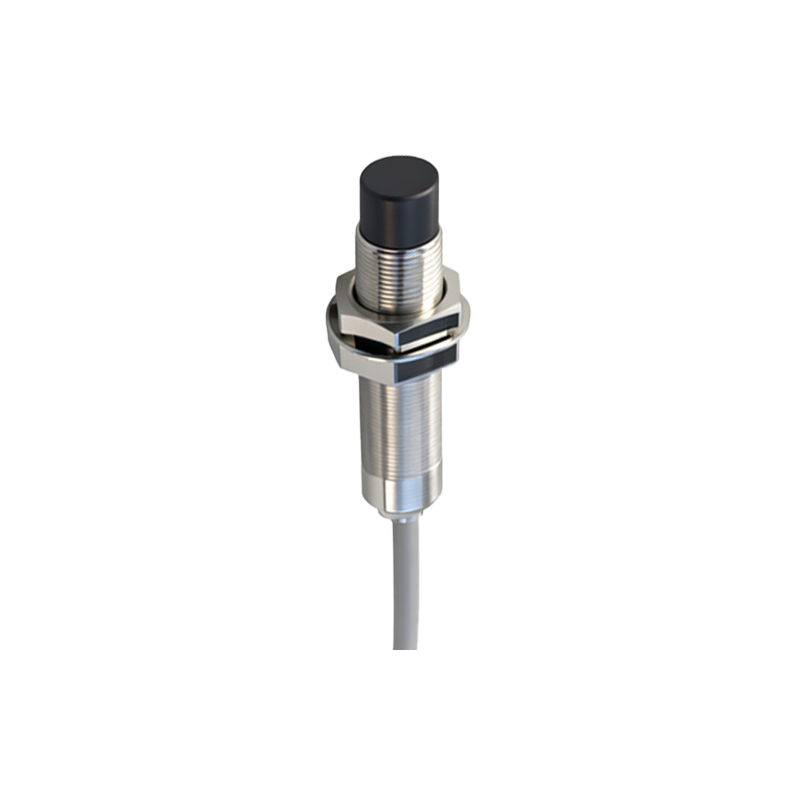
Installation and wiring of the LM30-3015NA require careful consideration. Proper mounting is essential for reliable operation. The sensor should be installed so that the target approaches the active face axially. Adequate clearance must be maintained between the sensor body and any surrounding metal (the "flush-mountable" or "non-flush-mountable" characteristic should be verified in the datasheet). Incorrect mounting near conductive materials can cause false triggering or a reduced sensing range. Wiring follows the standard three-wire convention for DC sensors: brown wire for positive supply (+V), blue wire for common negative (0V), and black wire as the switched output signal. A protective fuse or circuit breaker in the supply line is always recommended. For optimal performance in electrically noisy environments, the use of shielded cables, with the shield properly grounded at one end, is advisable to prevent electromagnetic interference (EMI) from causing erratic behavior.
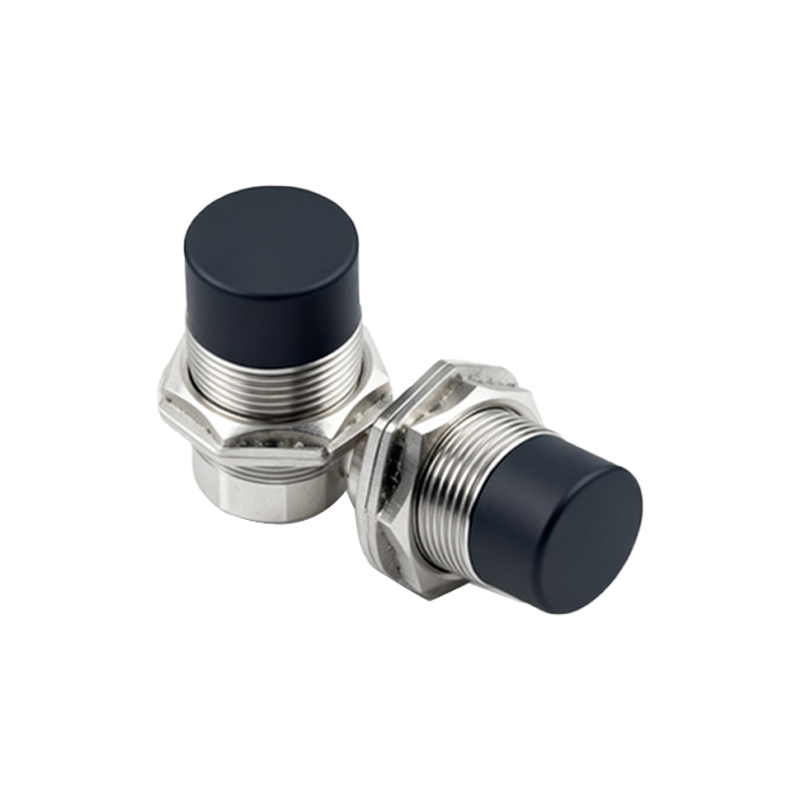
The application scope for the LM30-3015NA is vast. It is a workhorse in automated manufacturing for tasks such as part presence verification on conveyor belts, end-of-travel detection on linear actuators, and counting metallic objects. In material handling systems, it is used for pallet positioning and robotic arm guidance. Its rugged construction also makes it ideal for heavy machinery, where it can monitor the position of metal components or act as a safety interlock. When selecting this sensor for an application, engineers must consider not just the sensing distance, but also the target material, size, and approach speed, the required electrical output, and the environmental conditions including temperature extremes, potential chemical exposure, and mechanical vibrations.
In conclusion, the LM30-3015NA inductive proximity sensor represents a mature, reliable, and versatile solution for metallic object detection. Its straightforward operating principle, coupled with robust construction and standardized electrical interfaces, has cemented its place in countless industrial control systems. By thoroughly