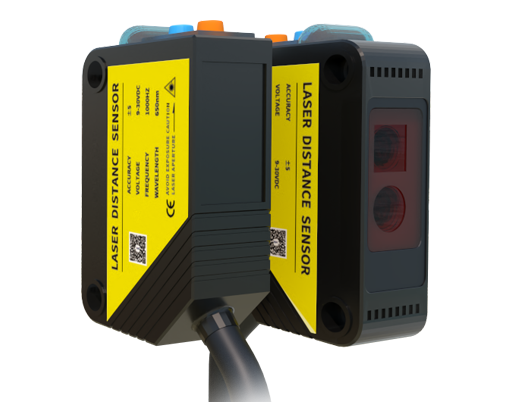
In the rapidly evolving landscape of industrial automation and precision measurement, the laser sensor operating at 5000 Hz represents a significant leap forward. This frequency, denoting 5000 measurement cycles per second, is not merely a specification but a critical parameter that defines the sensor's capability to capture high-speed processes with exceptional accuracy. The core technology enabling this performance typically involves advanced time-of-flight (ToF) or triangulation principles, coupled with high-speed photodetectors and sophisticated signal processing algorithms. For ToF-based sensors, a pulsed laser diode emits brief light bursts, and the time taken for the reflection to return is calculated to determine distance. At 5000 Hz, the sensor's electronics must process these time measurements with nanosecond precision, requiring robust noise immunity and thermal stability to maintain reliability in harsh environments.
The primary advantage of a 5000 Hz sampling rate is its ability to monitor fast-moving objects or dynamic processes without aliasing or loss of detail. In automotive manufacturing, for instance, such sensors are deployed on robotic assembly lines for real-time inspection of component positioning and weld seam tracking, where milliseconds matter. Similarly, in the packaging industry, they ensure precise fill-level detection and label placement on high-speed conveyor belts moving at several meters per second. The high data throughput allows for the creation of dense point clouds in 3D scanning applications, facilitating detailed quality control of complex geometries in aerospace component fabrication.
However, achieving stable operation at 5000 Hz presents engineering challenges. Key considerations include laser source selection, often a Class 2 or Class 1 laser for safety, with a wavelength (commonly 650 nm red or 850 nm infrared) chosen for the target material's reflectivity. The sensor's response time, linearity, and resolution are interdependent with its frequency; higher speeds can sometimes trade off against measurement range or resolution. Environmental factors like ambient light, dust, vibration, and temperature fluctuations must be mitigated through protective housings (IP67 ratings are standard) and intelligent filtering software. Modern 5000 Hz sensors frequently incorporate Ethernet/IP, PROFINET, or IO-Link interfaces for seamless integration into Industrial Internet of Things (IIoT) frameworks, enabling predictive maintenance through continuous performance data streaming.
When selecting a 5000 Hz laser sensor, engineers must evaluate the specific application demands: required measurement range (which may reduce at full frequency), spot size, output type (analog voltage, digital switch, or serial data), and mounting constraints. Calibration against known standards is essential to ensure long-term accuracy. As Industry 4.0 drives demand for higher throughput and smarter manufacturing, the 5000 Hz laser sensor stands as a pivotal tool, bridging the gap between rapid physical events and actionable digital data. Future advancements may see even higher frequencies paired with multi-sensor fusion and AI-driven analysis, further expanding their role in autonomous systems and precision engineering.