Laser sensors have become indispensable tools in modern industrial applications, particularly for precise distance measurement. These devices operate based on the principle of emitting a laser beam toward a target and analyzing the reflected signal to calculate distance. The most common methods include time-of-flight (ToF), triangulation, and interferometry, each suited for specific scenarios. Time-of-flight sensors measure the round-trip time of a laser pulse, offering long-range capabilities suitable for outdoor or large-scale environments like construction site monitoring and autonomous vehicle navigation. Triangulation sensors, using a laser emitter and a receiver positioned at a known angle, excel in high-accuracy short-range measurements, making them ideal for quality control on production lines, such as verifying component dimensions or surface profiles. Interferometry, though more complex, provides nanometer-level precision for research and ultra-fine manufacturing tasks.
The advantages of laser distance sensors are manifold. They deliver non-contact measurement, eliminating wear and tear on both the sensor and target object. High speed and accuracy enable real-time data acquisition, crucial for dynamic processes like robotic arm positioning or conveyor belt sorting. Additionally, many laser sensors are robust against environmental factors like dust or variable lighting, thanks to advanced filtering algorithms. However, challenges persist. Reflective or transparent surfaces can distort readings, requiring calibration or complementary sensor fusion. Cost can also be a consideration for high-end models, though the return on investment often justifies the expense through improved efficiency and reduced error rates.
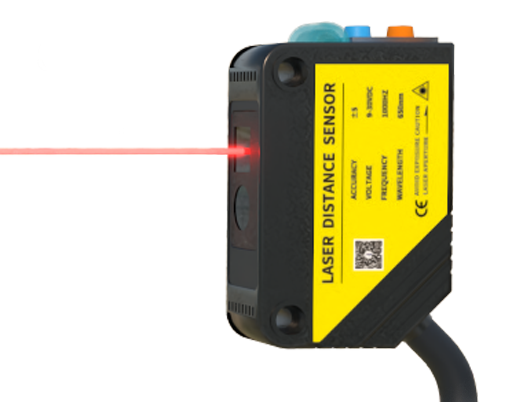
In practice, laser sensors are deployed across diverse sectors. In automotive manufacturing, they ensure precise alignment of parts during assembly. In logistics, they measure parcel dimensions for automated packaging systems. Aerospace applications include wing deflection testing and drone-based terrain mapping. Emerging trends integrate laser sensors with IoT platforms, enabling predictive maintenance by monitoring equipment displacement or vibration over time. As technology advances, miniaturization and enhanced AI-driven data processing are expanding their utility, paving the way for smarter, more adaptive industrial ecosystems. To maximize performance, users should select sensors based on range, resolution, and environmental compatibility, while adhering to safety standards for laser classification to prevent ocular hazards.
Overall, laser sensor distance measurement represents a cornerstone of industrial automation, driving precision and productivity. Its continuous evolution promises further innovations in fields like augmented reality for training or remote operation, solidifying its role in the future of engineering and technology.
