In the realm of industrial automation and machine control, proximity sensors are indispensable components for non-contact detection of metallic objects. Among the various configurations available, the 2-wire DC proximity sensor with an NPN output stands out for its simplicity, cost-effectiveness, and widespread applicability. This article delves into the operational principles, wiring methodologies, key advantages, and practical considerations for integrating these sensors into modern control systems.
A 2-wire DC NPN proximity sensor, fundamentally, operates on a two-wire connection scheme: one wire for the positive DC supply voltage (typically ranging from 10 to 30 VDC) and the other wire serving as both the load current return path and the signal output line. This contrasts with 3-wire or 4-wire sensors that have dedicated power, ground, and signal wires. The "NPN" designation refers to the type of transistor used in the sensor's output switching stage. An NPN transistor, in this context, acts as a low-side switch. When the sensor is inactive (no target detected), the output transistor is in an off state, presenting a high impedance. Upon detecting a valid target within its sensing range, the internal circuitry activates the NPN transistor, allowing current to flow from the load, through the sensor, and to the negative supply (common ground).
Wiring a 2-wire NPN sensor is notably straightforward. The two wires are connected in series with the load (e.g., a PLC input module, a relay coil, or an indicator lamp) and the power supply. One common configuration is to connect the brown wire (usually positive) to the positive DC supply terminal. The blue wire (usually the switched output) is then connected to one terminal of the load, and the other terminal of the load is connected to the negative side of the power supply. It is crucial to note that the load must be present for the sensor to function correctly, as the sensor itself requires a small quiescent current (leakage current) to power its internal electronics even in the off-state. This leakage current, typically under 2 mA, must be considered to avoid unintentional activation of highly sensitive loads.
The primary advantages of 2-wire NPN sensors are their reduced installation cost and space savings. With only two wires, they require less cabling, smaller conduit, and fewer connection points compared to their 3-wire counterparts. This makes them ideal for applications with space constraints or where a large number of sensors are deployed. Their simple series connection mimics a traditional mechanical switch, making them easy to understand and troubleshoot for maintenance personnel. Furthermore, they offer good noise immunity in many industrial environments.
However, certain practical considerations are paramount for reliable operation. First, the leakage current must be managed. If the load's minimum operating current is lower than the sensor's off-state leakage current, the load may remain partially energized or "chatter." Using a bleeder resistor in parallel with the load can often solve this issue. Second, voltage drop across the sensor in the on-state (saturation voltage) must be accounted for, as it reduces the voltage available to the load. Ensuring the supply voltage is adequately higher than the load's minimum operating voltage is essential. Third, while wiring is simple, polarity must be observed; reversing the wires will prevent the sensor from operating and could potentially damage it.
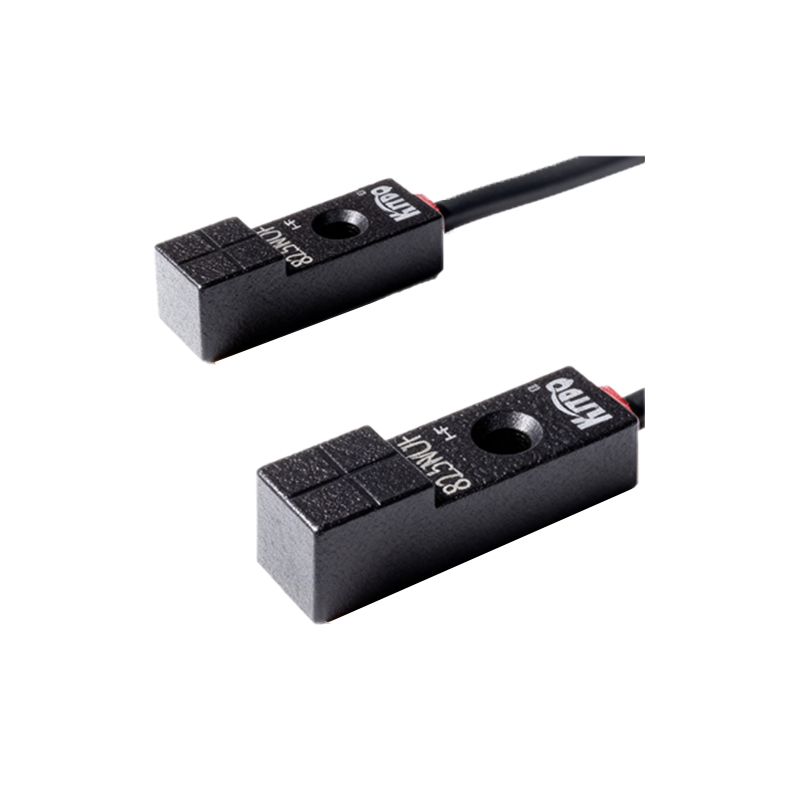
Typical applications for 2-wire DC NPN proximity sensors are abundant. They are extensively used in conveyor systems for part detection, in packaging machinery for counting and positioning, in automotive assembly lines for presence verification, and in material handling equipment for limit switching. Their robust construction, often featuring IP67 or higher ingress protection ratings, allows them to perform reliably in harsh conditions with dust, moisture, and vibration.
When selecting a 2-wire NPN sensor, key specifications to evaluate include the sensing distance, supply voltage range, switching frequency, housing material (e.g., brass, stainless steel, or PBT plastic), and output current capacity. It is also vital to ensure compatibility with the programmable logic controller (PLC) or other control device input characteristics. Most modern PLC DC input modules are designed to work seamlessly with both 2-wire and 3-wire sensor technologies.
In conclusion, the 2-wire DC NPN proximity sensor represents a elegant and efficient solution for countless detection tasks in industrial automation. Its design trade-offs—simplicity and cost versus considerations like leakage current—are well-understood within the industry. By carefully following wiring guidelines and accounting for its electrical characteristics during system design, engineers can leverage these sensors to build reliable, maintainable, and cost-effective control systems. Their continued prevalence is a testament to their fundamental utility in interfacing the physical world with digital control logic.