In the realm of industrial automation and control systems, the selection of appropriate sensing technology is paramount for ensuring reliability, safety, and efficiency. Among the diverse array of sensors available, the M8 plug-in three-wire NPN normally closed (NC) proximity sensor stands out as a fundamental component in countless applications. This article provides an in-depth technical exploration of this sensor type, covering its operating principles, key characteristics, wiring configurations, application scenarios, and selection considerations.
Fundamentally, a proximity sensor is a device that detects the presence or absence of an object without physical contact. The M8 designation refers to the standardized thread size of the sensor housing, which is 8 millimeters in diameter. This compact form factor makes it ideal for installations where space is constrained. The "plug-in" feature signifies that the sensor is equipped with a quick-disconnect connector, typically conforming to standards like the M8 3-pin male connector. This design facilitates easy installation, replacement, and maintenance, significantly reducing downtime compared to hard-wired alternatives.
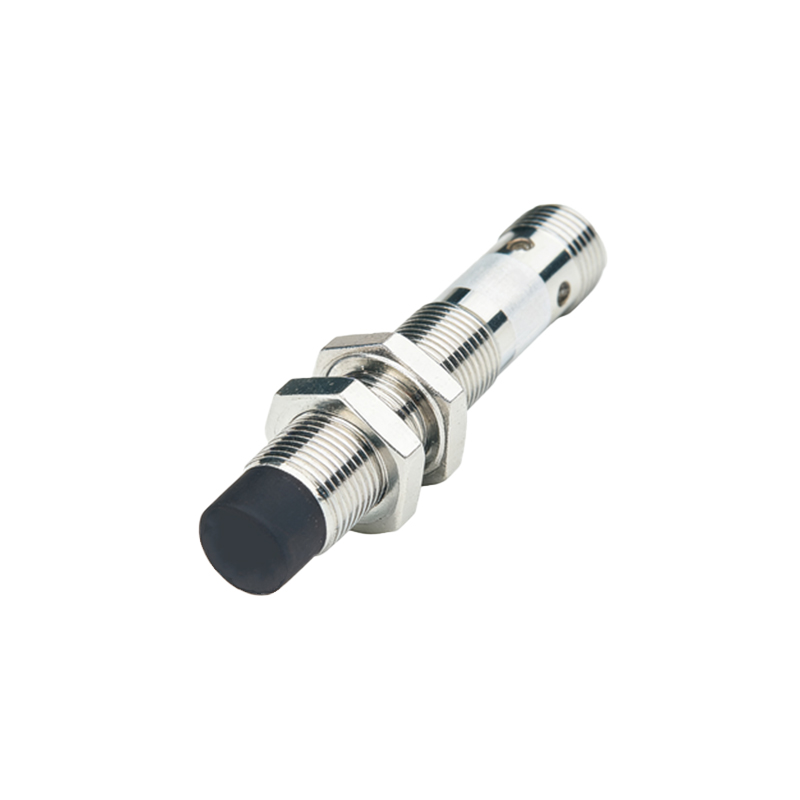
The electrical configuration is defined as "three-wire NPN." This indicates that the sensor requires three wires for operation: a brown wire for the positive supply voltage (typically +10 to +30 VDC), a blue wire for the common ground (0V), and a black wire as the signal output. The "NPN" designation describes the type of transistor used in the sensor's output switching circuit. In an NPN sensor, the output transistor switches the load to ground (0V). When the sensor is in its normal state (no target detected), the normally closed (NC) output provides a continuous circuit, allowing current to flow to the load. Upon detecting a target within its sensing range, the internal switch opens, interrupting the circuit and turning the load off. This fail-safe behavior is often preferred in safety-critical applications where an open circuit (sensor off) should indicate a fault or safe condition.
The sensing principle is usually based on inductive technology. An inductive proximity sensor generates an electromagnetic field from its sensing face. When a metallic target (such as steel, aluminum, copper, etc.) enters this field, eddy currents are induced in the target, causing a change in the oscillation amplitude within the sensor's internal coil. This change is detected by the sensor's circuitry, triggering the switching action. The sensing distance, or nominal range, for a standard M8 inductive sensor is typically up to 2 mm, though this can vary slightly depending on the target material and specific model. Key performance parameters include repeat accuracy, response frequency, temperature rating, and protection class (commonly IP67 for resistance to dust and temporary immersion).
Wiring an M8 plug-in three-wire NPN NC sensor is straightforward. The brown wire connects to the positive DC supply. The blue wire connects to the power supply's negative terminal (0V). The black output wire connects to one terminal of the load (e.g., a PLC input, relay coil, or indicator lamp). The other terminal of the load is then connected back to the positive supply rail. It is crucial to verify the sensor's voltage specifications and ensure the load current does not exceed the sensor's maximum switching capacity, often around 100-200 mA. A protective diode or suppressor may be required for inductive loads like relays to prevent voltage spikes from damaging the sensor's output transistor.
Application areas for this sensor are extensive. They are commonly employed in machine tools for position detection of tool holders or workpieces, in conveyor systems for counting or jam detection, in robotic arms for end-of-arm tooling presence verification, and in assembly lines for part verification. The normally closed configuration is particularly useful in safety interlock circuits, where a broken wire or sensor failure should cause the controlled machine to stop. For instance, a guard door monitored by an NC sensor would break the circuit and halt machinery if the door is opened.
When selecting an M8 plug-in three-wire NPN NC proximity sensor, engineers must consider several factors. First, the target material must be metallic for inductive types. For non-metallic targets, capacitive sensors would be required. The required sensing distance and mounting constraints (flush or non-flush) must be evaluated. Environmental conditions such as temperature extremes, presence of coolants, oils, or metal chips necessitate sensors with appropriate housing materials (often nickel-plated brass or stainless steel) and sealing ratings. Electrical compatibility with the controller (PLC, microcontroller) is essential; while NPN outputs are common in European and Asian designs, some systems may require PNP (sourcing) outputs. Finally, choosing a reputable manufacturer ensures product consistency, availability of technical data, and reliable performance over the sensor's operational lifespan.
In conclusion, the M8 plug-in three-wire NPN normally closed inductive proximity