In the landscape of industrial automation and precision measurement, laser displacement sensors have emerged as indispensable tools. These devices operate on the principle of triangulation or time-of-flight, projecting a focused laser beam onto a target surface and analyzing the reflected light to determine distance or position with exceptional accuracy. Their non-contact nature is a key advantage, allowing for measurements without physical interaction that could damage delicate surfaces or alter the properties of the object being measured. This makes them ideal for applications involving hot, soft, moving, or otherwise inaccessible targets.
The core functionality of a laser displacement sensor lies in its ability to provide high-speed, high-resolution data. Modern sensors can achieve sub-micron resolution and sampling rates in the kilohertz range, enabling real-time monitoring and control in dynamic processes. In manufacturing, for instance, they are routinely deployed for tasks such as thickness gauging of materials, vibration analysis of machinery components, and precise profiling of parts on assembly lines. The automotive industry relies on them for weld seam tracking and panel gap inspection, ensuring stringent quality standards. In electronics, they verify the coplanarity of integrated circuit leads and the height of surface-mount components.
Beyond dimensional checks, laser displacement sensors facilitate complex inspections like warp detection, edge detection, and presence sensing. Their versatility is further enhanced by various models tailored to different surface types—diffuse, specular, or transparent—and challenging environmental conditions. Some are equipped with robust housings for resistance to dust, coolant, and vibration commonly found in factory settings. The data output, typically analog voltage or current, digital values, or serial communication protocols, integrates seamlessly with PLCs (Programmable Logic Controllers) and data acquisition systems, forming the backbone of automated feedback loops.
However, selecting the appropriate sensor requires careful consideration of several parameters. The measuring range, spot size, linearity, and repeatability must align with the application's needs. Environmental factors like ambient light, temperature fluctuations, and the target's surface color or texture can influence performance. For example, a highly reflective surface might require a sensor with a specialized receiver or a diffused laser beam to prevent saturation, while a dark, absorbent surface might need a sensor with higher output power.
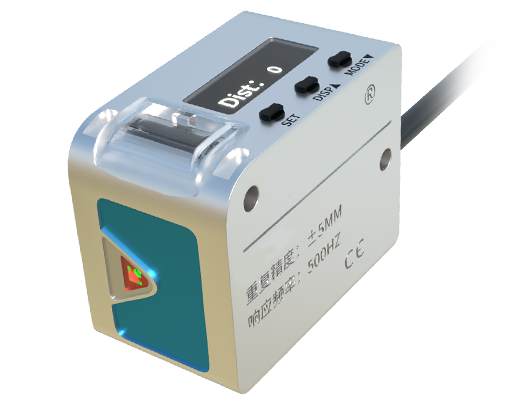
The evolution of laser displacement sensor technology continues to push boundaries. Advancements in CMOS (Complementary Metal-Oxide-Semiconductor) and CCD (Charge-Coupled Device) detectors, alongside sophisticated algorithms for signal processing, have improved stability and reduced measurement noise. The integration of Ethernet-based industrial communication, such as EtherCAT or PROFINET, allows for easier networking and data aggregation in Industry 4.0 frameworks. Looking forward, the convergence of sensor data with AI and machine learning promises even smarter predictive maintenance and quality control systems, where anomalies are detected not just by threshold breaches but through pattern recognition.
In conclusion, the laser displacement sensor is far more than a simple measuring device; it is a critical enabler of precision, efficiency, and quality in modern industrial operations. By providing reliable, non-contact dimensional data at high speeds, it empowers engineers to optimize processes, reduce waste, and maintain consistent product quality, solidifying its role as a cornerstone technology in advanced manufacturing and beyond.
