In the rapidly evolving landscape of industrial automation and quality control, 3D laser sensors have emerged as a cornerstone technology, driving unprecedented levels of precision, efficiency, and reliability. Unlike traditional 2D vision systems or contact measurement tools, these advanced sensors utilize laser triangulation, time-of-flight (ToF), or structured light principles to capture comprehensive three-dimensional data of objects and environments in real-time. This capability is fundamentally transforming a multitude of sectors, from automotive manufacturing and electronics assembly to logistics and robotics.
At its core, a 3D laser sensor projects a laser line or pattern onto a target surface. A high-resolution camera, positioned at a known angle to the laser source, captures the deformation of this pattern. Sophisticated algorithms then process this information to calculate depth and surface contour, generating a dense point cloud or a highly accurate 3D profile. This non-contact method is ideal for inspecting delicate, hot, or moving components where physical probes would be impractical or damaging.

The applications are vast and impactful. In automotive manufacturing, 3D laser sensors perform critical tasks such as weld seam inspection, gap and flush measurement between body panels, and robot guidance for precise part placement. They ensure that every vehicle meets stringent safety and aesthetic standards. In the electronics industry, these sensors verify the coplanarity of Ball Grid Array (BGA) components, inspect solder paste volume, and measure microscopic features on printed circuit boards (PCBs), preventing costly failures down the line.
Logistics and warehousing have been revolutionized by the integration of 3D laser sensors into automated guided vehicles (AGVs) and robotic picking systems. They enable robots to perceive bin contents in three dimensions, accurately identify and locate items of varying shapes and sizes, and execute precise pick-and-place operations, even in unstructured environments. This dramatically improves sorting accuracy and operational throughput.
Furthermore, in reverse engineering and quality assurance, 3D laser scanning provides a complete digital twin of a physical part. Engineers can compare the scanned data against the original CAD model to detect deviations, warpage, or defects with micron-level accuracy. This facilitates rapid prototyping, tooling verification, and ensures consistent production quality across high-volume runs.
The advantages of deploying 3D laser sensors are compelling. They offer high-speed data acquisition, often processing thousands of profiles per second, which is essential for inline inspection in fast-paced production lines. Their robustness allows them to perform reliably in harsh industrial conditions with varying ambient light, dust, and vibration. The richness of 3D data also reduces programming complexity for complex inspections, as features like height, volume, and surface orientation are directly measurable.
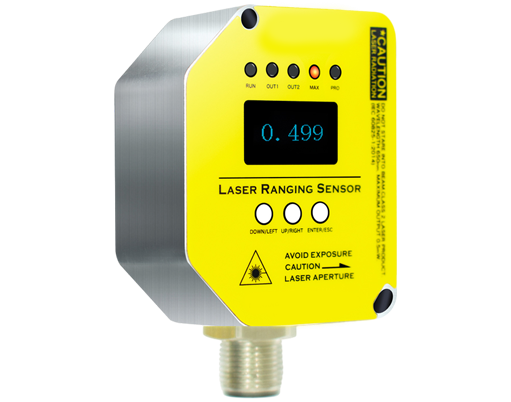
Looking ahead, the convergence of 3D laser sensing with artificial intelligence and edge computing is set to unlock even greater potential. Smart sensors with embedded AI can now not only capture data but also interpret it, making autonomous decisions for pass/fail grading or adaptive robot control. This shift towards intelligent perception is a key enabler for the next generation of flexible, self-optimizing smart factories.
In conclusion, 3D laser sensors are far more than just measurement devices; they are the eyes of modern industrial systems. By delivering rich, accurate, and actionable 3D data, they empower machines to interact with the physical world with a level of sophistication once thought impossible. As technology continues to advance, their role in enhancing automation, ensuring quality, and driving innovation across global industries will only become more profound and indispensable.