In the realm of industrial automation and control systems, proximity sensors are indispensable components for detecting the presence or absence of objects without physical contact. Among the various types available, 3-wire and 4-wire proximity sensors are widely used, each offering distinct advantages and suited for specific applications. This article delves into the technical nuances, wiring configurations, and practical considerations of these two common sensor types, providing a clear guide for engineers and technicians in the electrical and automation fields.
A proximity sensor, fundamentally, is a device that emits an electromagnetic field or a beam of electromagnetic radiation and looks for changes in the field or return signal. The object being detected is often referred to as the sensor's target. The primary distinction between 3-wire and 4-wire models lies in their internal circuitry and the method by which they interface with power supplies and load devices.
3-Wire Proximity Sensors: Simplicity and Commonality
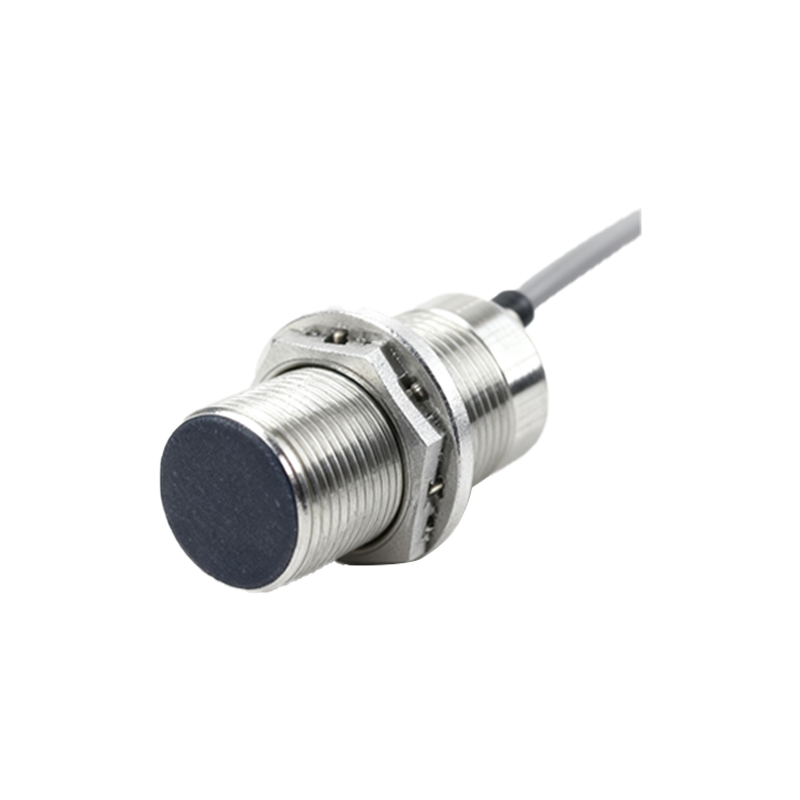
The 3-wire proximity sensor is arguably the most prevalent configuration in industrial settings. Its wiring typically consists of three conductors: one for power supply (V+ or brown wire), one for ground (0V or blue wire), and one for the output signal (black wire). These sensors are further categorized based on their output type: NPN (sinking) and PNP (sourcing).
In an NPN configuration, the output transistor switches the load to ground (0V). When the sensor is activated, it connects the output line to the ground, allowing current to flow from the load into the sensor. This is commonly used with PLCs (Programmable Logic Controllers) that have sinking input modules. Conversely, a PNP sensor switches the positive voltage to the load. When activated, it connects the output line to the positive supply voltage, sourcing current to the load. PNP outputs are typically paired with PLCs featuring sourcing input modules.
The key advantage of the 3-wire sensor is its simplicity and direct compatibility with standard DC control circuits. It requires only a single power supply and provides a straightforward switched output. However, it is crucial to match the sensor's output type (NPN/PNP) with the input requirements of the controller to avoid malfunction or damage.
4-Wire Proximity Sensors: Enhanced Functionality and Isolation
The 4-wire proximity sensor builds upon the 3-wire design by incorporating an additional wire, which usually provides a normally closed (NC) output contact alongside the standard normally open (NO) output. The typical wiring includes: power supply (V+, often brown), ground (0V, often blue), NO output (black), and NC output (white). Some 4-wire models may feature two independent outputs or a complementary output pair (one NO and one NC).
This configuration offers greater flexibility in control logic. The presence of both NO and NC contacts allows for more complex circuit designs without the need for external relays in some cases. For instance, one output can be used to activate a machine process, while the other can simultaneously trigger a safety interlock or a status indicator. This dual-output capability can simplify panel wiring and reduce component count.
A significant technical aspect of some 4-wire sensors is the potential for isolated outputs. In certain designs, the output circuits are electrically isolated from the sensor's power supply circuit. This isolation enhances noise immunity and protects sensitive control equipment from voltage spikes or ground loop issues, which is particularly valuable in electrically noisy industrial environments.
Choosing Between 3-Wire and 4-Wire: Application-Driven Decisions
The selection between a 3-wire and a 4-wire proximity sensor is not a matter of superiority but of application suitability.
For Standard On/Off Detection: A 3-wire sensor is usually sufficient and more cost-effective. Its widespread use means easier availability and replacement. Applications include part presence detection on conveyor belts, counting objects, or determining end-of-travel positions.
For Redundant Safety or Complex Logic: A 4-wire sensor is preferable when a control system requires confirmation via both NO and NC states. This is common in safety circuits where a fault condition must be positively signaled. They are also ideal for applications requiring two separate control signals from a single sensing point.
For Noisy Electrical Environments: If the installation site has significant electromagnetic interference, a 4-wire sensor with isolated outputs can provide more reliable operation and protect downstream controllers.
When integrating these sensors, always consult the manufacturer's datasheet for precise wiring diagrams, voltage ratings (commonly 10-30V DC), current capacity, and environmental specifications (IP rating, temperature range). Proper shielding and grounding are essential for long cable runs to prevent false triggering.
In conclusion, both 3-wire and 4-wire proximity sensors are vital tools in an engineer's arsenal