In modern industrial automation, laser positioning sensors have become indispensable tools for achieving high-precision measurements and control. These sensors utilize laser technology to detect the position, distance, or displacement of objects with remarkable accuracy, playing a critical role in applications ranging from robotics and manufacturing to quality inspection and logistics. However, the accuracy of laser positioning sensors is not a fixed value; it depends on various factors that engineers must consider to ensure optimal performance in specific environments.
Accuracy in laser positioning sensors refers to the closeness of the measured value to the true value of the target's position. It is typically expressed in units such as micrometers (µm) or millimeters (mm), with high-end sensors capable of sub-micron accuracy. Several key elements influence this accuracy, including sensor design, environmental conditions, target properties, and installation practices.

First, the inherent design of the sensor determines its baseline performance. Factors like laser wavelength, beam quality, detector resolution, and signal processing algorithms directly impact precision. For instance, sensors using blue lasers often provide better accuracy on reflective surfaces compared to red lasers due to shorter wavelengths. Additionally, advanced digital filtering and noise reduction techniques in the electronics can enhance stability and repeatability, reducing errors over time.
Environmental conditions pose significant challenges to accuracy. Temperature fluctuations can cause thermal expansion in sensor components, leading to drift in measurements. Industrial settings may also involve vibrations, dust, or humidity, which can scatter the laser beam or interfere with detection. To mitigate these issues, many sensors incorporate temperature compensation mechanisms and protective housings rated for harsh environments. Ensuring stable operating conditions through proper enclosure and climate control is essential for maintaining long-term accuracy.
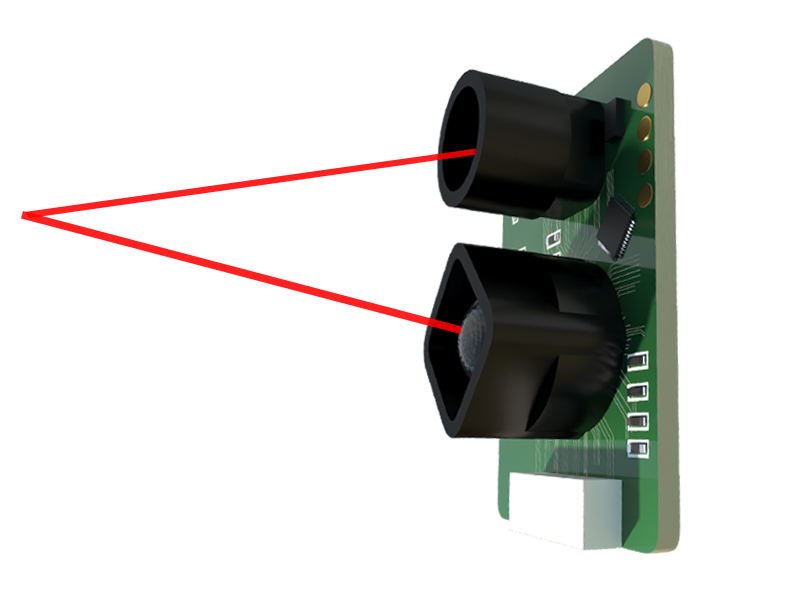
The characteristics of the target object itself are equally important. Surface color, texture, reflectivity, and angle of incidence affect how the laser beam is reflected back to the sensor. Dark or matte surfaces may absorb more light, reducing signal strength, while shiny surfaces can cause specular reflections that lead to false readings. Some sensors offer adjustable sensitivity or multiple measurement modes to adapt to different materials. In critical applications, using targets with consistent properties or applying reflective markers can improve reliability.
Installation and calibration are practical steps that directly influence accuracy. Proper alignment of the sensor relative to the target is crucial; even minor misalignments can introduce cosine errors or parallax effects. Following manufacturer guidelines for mounting distance, angle, and stability helps minimize such errors. Regular calibration against known standards ensures that the sensor maintains its specified accuracy over time. Many modern sensors feature automatic calibration routines or integration with software tools for easy verification.

Applications demanding high accuracy, such as semiconductor manufacturing, precision assembly, or coordinate measuring machines, often require sensors with specialized features. For example, time-of-flight (ToF) sensors excel in long-range distance measurements, while triangulation-based sensors offer superior accuracy at close ranges. Confocal or interferometric sensors provide nanometer-level precision for ultra-fine tasks. Selecting the right type based on range, resolution, and environmental needs is key to achieving desired outcomes.
In conclusion, laser positioning sensor accuracy is a multifaceted attribute shaped by technical design, environmental factors, target interactions, and user practices. Engineers must evaluate these aspects holistically when integrating sensors into systems. By understanding the underlying principles and adhering to best practices, industries can leverage laser technology to enhance efficiency, quality, and automation capabilities. As advancements continue, with innovations like AI-enhanced signal processing and multi-sensor fusion, the pursuit of higher accuracy will drive further improvements in industrial productivity and innovation.