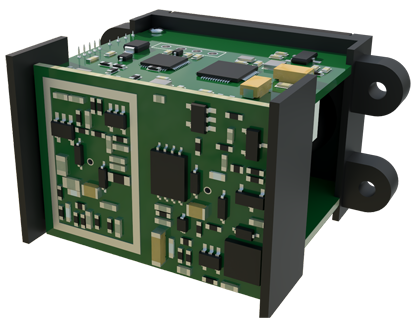
In the realm of industrial automation, robotics, and precision measurement, laser distance positioning sensors have become indispensable tools. These sophisticated devices offer unparalleled accuracy, speed, and reliability for non-contact measurement and positioning tasks. This article delves into the fundamental principles, diverse applications, and key considerations for selecting the right sensor for your specific needs.
At its core, a laser distance positioning sensor operates by emitting a focused beam of laser light towards a target object. The sensor then analyzes the light that is reflected back to a detector within the unit. The primary technologies employed are Time-of-Flight (ToF) and triangulation. Time-of-Flight sensors calculate distance by precisely measuring the time it takes for the laser pulse to travel to the target and back. Given the constant speed of light, this time interval directly correlates to the distance. This method is highly effective for long-range measurements, often up to several hundred meters, with typical accuracies in the millimeter to centimeter range. It is widely used in applications like vehicle LiDAR, warehouse inventory management, and large-scale surveying.
The triangulation method, on the other hand, is preferred for high-precision, short to medium-range applications. Here, the laser emitter, the reflected spot on the target, and the position-sensitive detector (PSD or CMOS) form a triangle. The angle at which the reflected light hits the detector changes with the target's distance. By calculating this angle, the sensor determines the distance with exceptional resolution, often in the micrometer range. This makes triangulation sensors ideal for tasks such as inspecting component thickness, monitoring vibration or deformation, and guiding assembly robots.

The applications for laser distance sensors are vast and continually expanding. In manufacturing, they are crucial for precise positioning of parts on conveyor belts, controlling robotic arm trajectories, and ensuring quality control through dimensional verification. In the construction industry, they facilitate leveling, alignment, and volume calculations. Logistics and warehousing benefit from their use in palletizing, dimensioning packages, and automated guided vehicle (AGV) navigation. Furthermore, they play a vital role in research and development, process automation, and even in consumer electronics for features like autofocus and gesture recognition.

When selecting a laser distance positioning sensor, several critical parameters must be evaluated. First is the measuring range, which defines the minimum and maximum distances the sensor can reliably handle. The accuracy and resolution specify the sensor's precision and the smallest detectable change in distance, respectively. The response time or measurement rate is crucial for dynamic or high-speed applications. Environmental factors cannot be overlooked; considerations include the target properties (color, reflectivity, material, and surface texture), ambient light conditions, and the presence of dust, moisture, or temperature variations, which dictate the required Ingress Protection (IP) rating.
Other important factors include the output interface (analog voltage/current, digital protocols like IO-Link, RS-232, or Ethernet), mounting options, and the physical size of the sensor. For demanding environments, models with robust housings and specialized optics are available. It is also essential to consider the ease of configuration and the availability of software tools for setup and diagnostics.
In conclusion, laser distance positioning sensors are powerful instruments that bridge the gap between physical objects and digital control systems. Understanding the underlying technology—be it ToF for long-range or triangulation for high precision—is the first step. By carefully matching the sensor's specifications, such as range, accuracy, speed, and environmental robustness, to the application's demands, engineers can unlock significant gains in efficiency, quality, and automation capability. As technology advances, these sensors continue to become more compact, intelligent, and cost-effective, promising even broader integration into the smart factories and interconnected systems of the future.