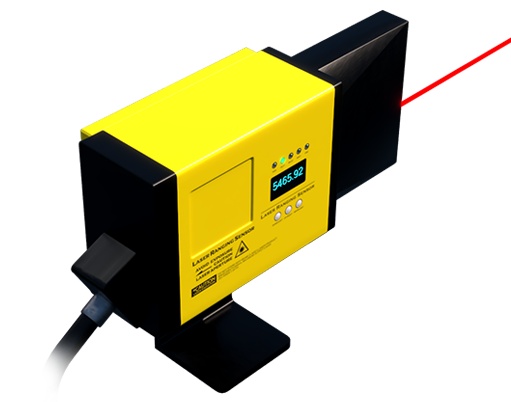
Laser displacement sensors are non-contact measurement devices that utilize a focused laser beam to determine the distance to a target object with exceptional precision. Operating on the principle of optical triangulation or time-of-flight measurement, these sensors project a laser spot onto the target surface. The reflected light is then captured by a receiving element, such as a CCD or PSD. By calculating the angle or the time delay of the reflected beam, the sensor's internal processor accurately computes the displacement or position of the target. This fundamental principle enables high-speed, high-accuracy measurements critical for modern automation and quality control.
The core technology can be broadly categorized into two types: triangulation-based sensors and time-of-flight (ToF) sensors. Triangulation sensors are renowned for their micron-level resolution and are ideal for measuring small displacements on precise components, such as in semiconductor manufacturing or electronics assembly. In contrast, ToF sensors measure the time it takes for a laser pulse to travel to the target and back, making them suitable for longer measurement ranges, though typically with slightly lower resolution. They are extensively used in applications like bulk material level monitoring, vehicle detection, and large-scale robotic guidance.
Selecting the appropriate laser displacement sensor requires careful consideration of several key parameters. Measurement range defines the minimum and maximum distances over which the sensor can operate accurately. Resolution indicates the smallest detectable change in distance, while linearity specifies the maximum deviation from a perfect straight-line output over the entire range. Spot size is crucial as it affects measurement stability on curved or textured surfaces; a smaller spot allows for finer feature measurement but may be more susceptible to surface imperfections. Furthermore, sampling speed, expressed in Hertz (Hz), determines how quickly the sensor can take measurements, which is vital for high-speed production lines.

Industrial applications of laser displacement sensors are vast and transformative. In automotive manufacturing, they are deployed for 100% inline inspection of critical dimensions like body panel gaps, brake disc thickness, and piston position. The electronics industry relies on them for measuring component coplanarity, solder paste height, and PCB warpage. Within the metals and rolling mills, these sensors provide continuous, non-contact thickness profiling of sheets and strips, ensuring product consistency. Robotics integration is another growing field, where laser sensors provide real-time feedback for precise path correction, bin-picking, and assembly tasks, enhancing flexibility and accuracy.
Environmental factors significantly influence sensor performance and must be accounted for during system integration. Target surface characteristics—including color, material, reflectivity, and texture—can affect the intensity and quality of the reflected laser beam. Many modern sensors feature automatic gain control or teach-in functions to compensate for these variations. Ambient light, particularly strong infrared or direct sunlight, can interfere with the sensor's receiver. Choosing models with modulated laser light or specialized optical filters is essential for stable operation in such conditions. Vibration and temperature fluctuations in industrial settings can also impact measurement stability, necessitating sensors with robust mechanical design and built-in temperature compensation circuits.
The future of laser displacement sensing is being shaped by several key trends. The integration of advanced sensor data directly into Industrial IoT (IIoT) and Industry 4.0 networks allows for predictive maintenance and big data analytics, transforming raw measurement data into actionable intelligence. The development of blue laser technology offers advantages for measuring shiny or transparent materials, such as glass or polished metal, which traditionally challenge red lasers due to specular reflection. Furthermore, the miniaturization of sensor heads and the proliferation of compact, embedded controllers are enabling their use in increasingly confined spaces and on smaller machinery, expanding the horizons of automated precision measurement across all sectors of modern industry.
In conclusion, laser displacement sensors are indispensable tools in the precision measurement arsenal. Their ability to deliver fast, accurate, and reliable non-contact data is a cornerstone of automated quality assurance, process control, and robotic guidance. A thorough understanding of their operating principles, types, key selection criteria, and application best practices is essential for engineers and system integrators to fully leverage their capabilities, driving efficiency, quality, and innovation in manufacturing and beyond.