Laser micro-displacement sensors represent a pinnacle of precision measurement technology in modern industrial automation and quality control. These non-contact devices utilize the principle of laser triangulation or interferometry to measure minute displacements, typically in the sub-micron to millimeter range, with exceptional accuracy and speed. At their core, a laser diode projects a focused beam onto the target surface. The reflected light is then captured by a high-resolution position-sensitive detector (PSD) or a CMOS/CCD sensor. Any change in the distance to the target causes a shift in the position of the reflected light spot on the detector. Sophisticated onboard electronics calculate this shift, converting it into a precise distance measurement. This fundamental operating principle enables measurements that are immune to the mechanical wear, hysteresis, and contact force issues inherent in traditional tactile probes.
The advantages of laser displacement sensors are manifold. Their non-contact nature makes them ideal for measuring delicate, soft, or hot surfaces that could be damaged or altered by physical touch. They offer extremely high sampling rates, often in the kilohertz range, allowing for real-time monitoring of dynamic processes such as vibration, runout, or fast-moving production lines. Furthermore, they provide high linearity and resolution, with some models achieving nanometer-level repeatability. This makes them indispensable in applications requiring stringent tolerances.
In practical industrial applications, these sensors are ubiquitous. In semiconductor manufacturing, they measure wafer warpage, film thickness, and precise stage positioning. In automotive assembly, they verify the gap and flushness between body panels with incredible consistency. In electronics production, they inspect solder paste height, component coplanarity, and connector pin position. They are also critical in precision machining for tool wear compensation, in medical device manufacturing for catheter diameter verification, and in research laboratories for material deformation studies under stress.
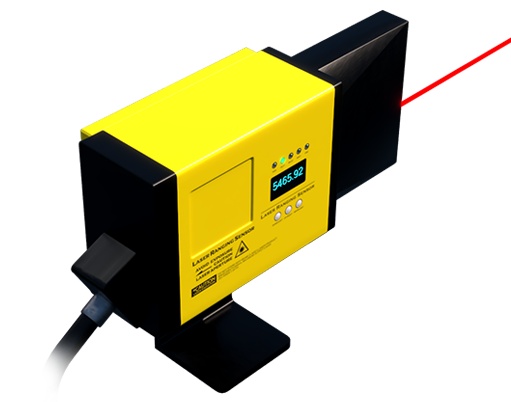
Selecting the appropriate laser micro-displacement sensor requires careful consideration of several key parameters. Measurement range, often a trade-off with resolution, must suit the specific application. Spot size is crucial; a smaller spot allows for higher resolution and measurement of fine features but requires a more stable surface. The type of target surface significantly impacts performance. Polished, mirror-like surfaces can cause specular reflection issues, often requiring sensors with coaxial or diffuse reflection technology, while dark or absorbing materials may require a sensor with higher laser power. Environmental factors such as ambient light, temperature fluctuations, and vibrations must also be accounted for, potentially necessitating models with robust housings, integrated cooling, or specialized filters.
Modern advancements continue to push the boundaries of this technology. Confocal chromatic sensors offer superior performance on transparent or multi-layered materials. Blue laser models provide better performance on organic materials like rubber or copper compared to traditional red lasers. Integration with smart factory systems is seamless through various industrial communication protocols like EtherCAT, PROFINET, and IO-Link, enabling predictive maintenance and data analytics. When implementing these systems, proper mounting, alignment, and calibration are paramount. Regular maintenance, including lens cleaning and verification against a calibrated standard, ensures long-term measurement integrity.
In conclusion, laser micro-displacement sensors are a foundational technology for achieving and verifying precision in advanced manufacturing and research. Their ability to deliver fast, accurate, and reliable non-contact measurements solves complex challenges across countless industries. A thorough understanding of their operating principles, application-specific requirements, and selection criteria is essential for engineers and technicians to fully leverage their capabilities, thereby enhancing product quality, optimizing processes, and driving innovation forward in an increasingly demanding technological landscape.