In the realm of industrial automation and control systems, proximity sensors stand as fundamental components for non-contact object detection. Among the diverse range of form factors and wiring configurations, the two-wire M18 proximity sensor has emerged as a particularly popular and versatile solution. This article delves into the technical specifications, operational principles, application considerations, and comparative advantages of these ubiquitous devices, tailored for electrical engineers and industry professionals.
The "M18" designation refers to the sensor's cylindrical housing diameter of 18 millimeters. This standardized size offers an excellent balance between physical robustness, sensing range, and ease of installation, fitting into a vast array of mounting brackets and fixtures common on production lines and machinery. The "two-wire" aspect is a critical feature that simplifies system design and installation. Unlike three-wire or four-wire sensors that require separate power, ground, and signal lines, a two-wire sensor integrates seamlessly into a single loop, analogous to a traditional switch. It is connected in series with the load (e.g., a PLC input, relay coil, or indicator lamp) and the power supply. This drastically reduces wiring complexity, material costs, and installation time, making it an economical choice for large-scale deployments.
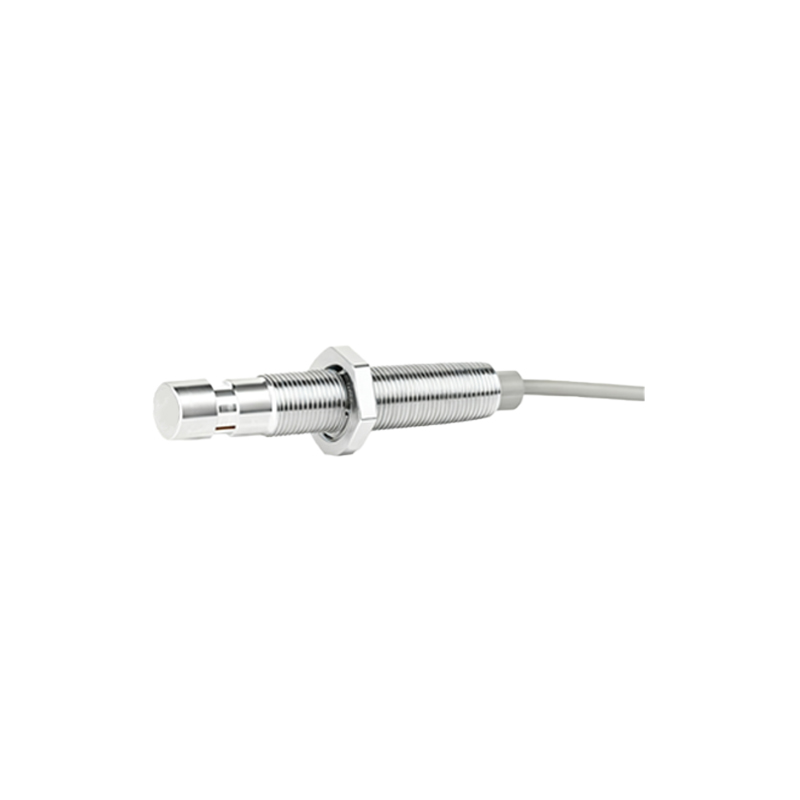
Operationally, two-wire M18 proximity sensors are predominantly based on inductive or capacitive sensing technologies. Inductive sensors are the workhorses for detecting metallic objects. They generate an oscillating electromagnetic field from a coil housed within the sensor face. When a conductive metal target enters this field, eddy currents are induced, causing a change in the oscillation amplitude. The sensor's internal circuitry detects this change and triggers a switching action. Capacitive sensors, on the other hand, can detect both metallic and non-metallic materials (plastics, wood, liquids) by sensing changes in capacitance caused by the target object's dielectric properties.
The switching function itself is a key consideration. Two-wire sensors are available in two primary output types: Normally Open (NO) and Normally Closed (NC). In an NO configuration, the switch closes (allows current to flow) when a target is present. In an NC configuration, the switch opens (stops current flow) upon target detection. The choice depends on the fail-safe requirements of the control logic. Furthermore, these sensors can be sourcing (PNP) or sinking (NPN) types, though the two-wire design inherently handles AC or DC power and manages the residual current ("leakage current") when in the "off" state, which must be considered to avoid inadvertently activating sensitive loads.
Key technical parameters for selection include:
Sensing Range: Typically from 2mm to 8mm for standard inductive M18 models. A "factor of safety" is often applied, selecting a sensor with a nominal range 20-30% greater than the required application distance.
Supply Voltage: Broad ranges are common, such as 10-30V DC or 20-250V AC, offering flexibility in various electrical environments.
Output Current (Switching Capacity): This defines the maximum load the sensor can handle. Engineers must ensure the sensor's rated current exceeds the load requirement, including inrush currents for inductive loads like relays.
Switching Frequency: Indicates how many on/off cycles per second the sensor can perform, critical for high-speed counting or positioning applications.
Housing Material: Typically nickel-plated brass or stainless steel (e.g., 316L) for corrosion resistance in harsh environments like food processing or washdown areas.
Protection Rating: An IP67 or IP68 rating is standard, ensuring protection against dust ingress and temporary or prolonged immersion in water.
Application scenarios for two-wire M18 sensors are extensive. They are ideal for simple presence/absence detection, part counting on conveyors, limit sensing on actuators, verifying end positions in pneumatic cylinders, and monitoring bin levels. Their simple wiring makes them perfect for retrofitting into existing control panels where space and wiring ducts are constrained.
When compared to three-wire sensors, the two-wire variant's primary advantage is wiring simplicity and cost savings on cables and connectors. However, this comes with trade-offs. Two-wire sensors have a inherent voltage drop and a small leakage current in the off state. They may also have a slightly lower switching frequency and be more sensitive to electrical noise on the line. Three-wire sensors offer more stable performance, higher switching speeds, and negligible leakage current, making them preferable for high-precision or high-speed applications and for directly interfacing with modern solid-state PLC inputs.
In conclusion, the two-wire M18 proximity sensor is a cornerstone of efficient and cost-effective industrial sensing. Its rugged design, simplified installation, and reliable performance under a wide range of conditions make it a default choice for countless automation