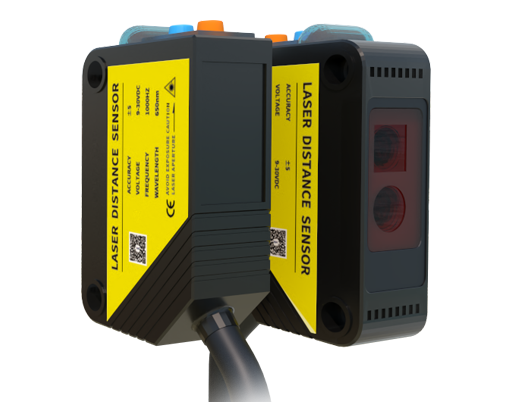
In the realm of industrial automation, precision, reliability, and efficiency are paramount. Among the myriad of sensing technologies available, the laser sensor bar, also known as a laser array sensor or laser light curtain, stands out as a critical component for advanced measurement, detection, and control applications. This article delves into the operational principles, key features, diverse applications, and selection criteria for laser sensor bars, providing a thorough understanding for engineers and system integrators.
At its core, a laser sensor bar consists of a linear array of synchronized laser emitters and photoelectric receivers. Unlike single-point sensors, this configuration creates a continuous "curtain" or plane of laser light. The fundamental principle involves the emission of modulated laser beams from one side of the bar. The corresponding receivers on the opposite side detect these beams. An object interrupting this light plane causes a specific receiver or a sequence of receivers to register a signal loss or change. This event is processed by the sensor's internal controller to determine the object's presence, position, height, profile, or even contour with exceptional accuracy. Modern units often employ Class 1 or Class 2 laser diodes, which are eye-safe under normal operating conditions, and utilize infrared or visible red wavelengths.
The defining characteristics of laser sensor bars make them indispensable in demanding environments. First and foremost is their high resolution, determined by the pitch between individual laser beams. Pitches can range from sub-millimeter for ultra-fine detection to several millimeters for larger object profiling. This enables the detection of very small objects or precise edge positioning. Secondly, they offer fast response times, typically in the microsecond range, making them suitable for high-speed production lines, such as in packaging or electronics assembly. Their long sensing range is another advantage, with some models capable of effective operation over several meters, facilitating applications like large material handling or vehicle detection. Furthermore, environmental robustness is key. High-quality laser bars are designed with IP67 or higher ingress protection ratings, resisting dust, water jets, and common industrial vibrations. They also often feature advanced algorithms to compensate for ambient light interference, ensuring stable performance under varying lighting conditions.
The application spectrum for laser sensor bars is remarkably broad. In material handling and logistics, they are used for palletizing, dimensioning packages (checkweigher systems), and ensuring correct box sealing by detecting flap presence. Within automotive manufacturing, they guide robots for precise windshield placement, verify door panel gaps, and inspect tire treads. In the pharmaceutical and food & beverage sectors, they ensure proper fill levels in bottles, detect missing caps or labels on moving lines, and verify tablet or candy count. They are also crucial in safety applications, serving as non-contact safety light curtains around hazardous machinery to protect personnel. Additionally, in electronic component assembly, they precisely position circuit boards and inspect solder paste height.

Selecting the appropriate laser sensor bar requires careful consideration of several parameters. The required resolution or beam pitch is dictated by the smallest feature needing detection. The effective sensing range must accommodate the physical setup of the application. The response speed must match or exceed the line speed to avoid missed detections. Environmental factors like temperature extremes, potential for mechanical shock, and exposure to cleaning chemicals dictate the necessary housing and protection rating. Output options (e.g., NPN/PNP, analog, Ethernet/IP, PROFINET) must be compatible with the existing PLC or control system. Finally, specialized software for configuration and diagnostics can significantly ease integration and maintenance.
In conclusion, laser sensor bars represent a sophisticated and versatile sensing solution that addresses complex challenges in modern industrial automation. Their ability to provide precise, non-contact, and high-speed linear measurement across a wide area makes them superior to traditional mechanical or single-point optical sensors for many tasks. As Industry 4.0 and smart factory concepts evolve, the integration of these sensors with IoT platforms and data analytics will further enhance process transparency, predictive maintenance, and overall operational intelligence. For engineers aiming to optimize automation systems, a deep understanding of laser sensor bar technology is not just beneficial—it is essential.