In modern automotive engineering, precision measurement is paramount. Among the various technologies enabling this, laser displacement sensors have emerged as a critical component. This article delves into the fundamental operating principle of these sensors, explaining how they contribute to enhanced vehicle safety, manufacturing quality, and advanced driver-assistance systems.
At its core, a laser displacement sensor is a non-contact measurement device. It operates by projecting a focused beam of laser light onto a target surface—which could be a brake disc, a body panel during assembly, or an object in the vehicle's path. The key principle involves measuring the distance to this target by analyzing the behavior of the reflected light. The most common method employed in automotive applications is the triangulation principle.
Here is a step-by-step breakdown of the triangulation principle:
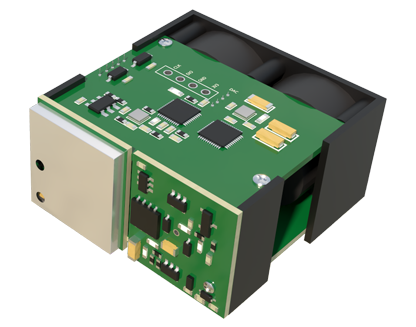
1. Laser Emission: A laser diode emits a coherent, focused beam of light onto a specific point on the target object.

2. Light Reflection: The target surface reflects this laser beam. The nature of the reflection (diffuse or specular) depends on the surface texture, which is why sensors are often optimized for specific materials.
3. Light Reception: The reflected light is not captured directly back along the emission path. Instead, it travels at an angle and is focused by a receiving lens onto a sensitive optical detector, typically a Position Sensitive Device (PSD) or a Charge-Coupled Device (CCD) / CMOS linear image sensor.
4. Position Calculation: The crucial part is the fixed, known geometric relationship between the laser emitter, the receiving lens, and the detector. This forms a triangle. When the target distance changes, the point where the reflected light spot hits the detector shifts linearly.
5. Displacement Output: The sensor's internal processor calculates the exact displacement (distance change) of the target based on this spot position shift using trigonometric algorithms. This result is then output as a high-resolution analog or digital signal.
This non-contact method offers significant advantages for automotive use. It avoids mechanical wear, allows for high-speed measurement on moving parts, and is unaffected by the electromagnetic interference common in vehicle environments. For instance, on a production line, these sensors precisely measure the gap and flushness between doors and body panels, ensuring perfect fit and finish. In vehicle safety systems, they can be part of LiDAR modules, helping to create high-definition 3D maps of the surroundings by scanning laser points across a scene.
Another important principle, used for longer ranges relevant to advanced driver-assistance systems (ADAS), is Time-of-Flight (ToF). In this method, the sensor measures the time delay between emitting a laser pulse and receiving its reflection. Since the speed of light is constant, the distance can be calculated directly from this time interval (Distance = (Speed of Light × Time Delay) / 2). ToF sensors are fundamental in areas like adaptive cruise control and collision avoidance.
The performance of an automotive laser displacement sensor is characterized by its resolution (smallest detectable change), linearity (measurement accuracy across its range), and sampling speed. Engineers select sensors based on the specific application, whether it's micron-level precision in engine component inspection or meter-level ranging for autonomous navigation.
In summary, the functionality of automotive laser displacement sensors hinges on precise optical triangulation or time-of-flight measurement. By converting the physical position of a reflected laser spot into an electrical signal, they provide the reliable, accurate, and real-time distance data that is indispensable in today's automated manufacturing and intelligent vehicles. Their continued evolution supports the industry's drive towards zero-defect production and higher levels of vehicular autonomy.