Proximity eddy current sensors, a cornerstone of non-contact measurement in modern industrial automation, operate on the principle of electromagnetic induction. When an alternating current passes through the sensor's coil, it generates an oscillating magnetic field. When a conductive target enters this field, eddy currents are induced on the target's surface. These eddy currents, in turn, generate their own magnetic field, which opposes the original field from the coil. The sensor's electronics detect changes in the coil's impedance—a combination of resistance and inductance—caused by this interaction. This change is precisely correlated to the distance (gap) between the sensor and the target, enabling high-precision displacement and position measurement. Their unique ability to function without physical contact makes them ideal for applications involving high speeds, extreme environments, or delicate surfaces. The diversity of industrial challenges has led to the development of several specialized types of proximity eddy current sensors.
The most fundamental categorization is based on the sensor's construction and output type. Standard Analog Output Sensors are the workhorses of the industry. They provide a continuous voltage (typically 0-10 V DC) or current (typically 4-20 mA) signal that is linearly proportional to the distance to the target. This analog signal is perfect for continuous monitoring tasks like checking runout on a rotating shaft, controlling gap in a precision press, or measuring thermal expansion of critical components. Their resolution can be sub-micron, and frequency responses often exceed 10 kHz, allowing them to capture very fast motion and vibration.
For applications requiring a simple go/no-go decision or event triggering, Digital (Switch) Output Sensors are employed. These sensors incorporate an internal comparator circuit. When the target reaches a preset distance threshold, the sensor's output switches from one state to another (e.g., from 0V to 24V). This digital signal is robust and easily interfaced with PLCs (Programmable Logic Controllers) for tasks like part presence detection, limit switching, or counting. They offer high repeatability and are less susceptible to electrical noise on the signal line compared to analog signals over long distances.
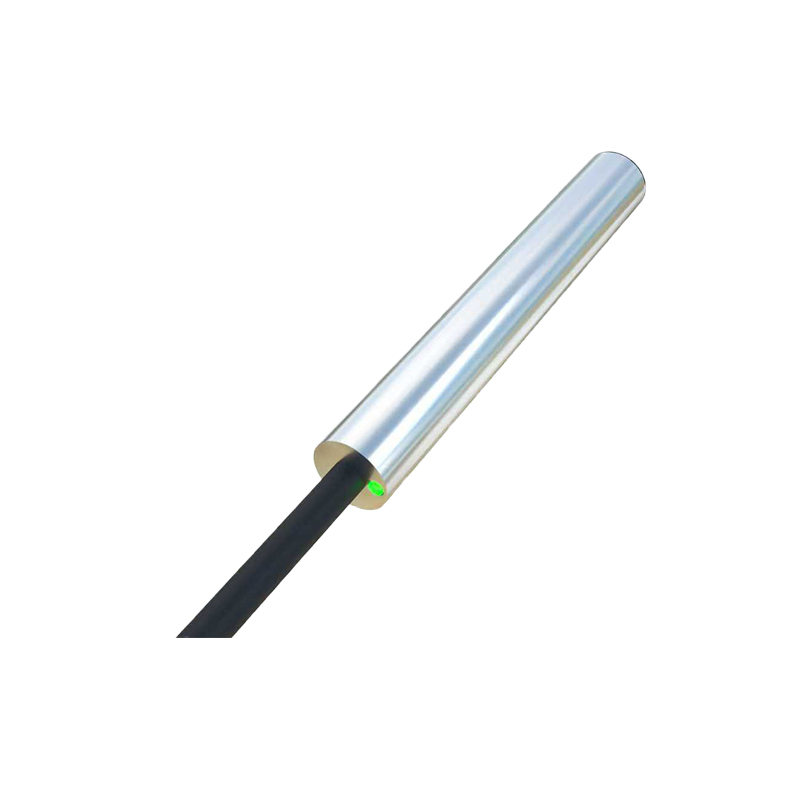
Beyond output type, sensor design is tailored to physical and environmental constraints. High-Temperature Sensors are engineered with specialized materials, such as high-temperature cables, high-purity alumina ceramics, and heat-resistant epoxy. They are designed to withstand ambient temperatures often up to 200°C (392°F) and even higher with air or water cooling jackets. These are indispensable in industries like metallurgy, for measuring roll positions in hot rolling mills, or in gas turbine engines for monitoring blade tip clearance.
In contrast, Miniature and Sub-Miniature Sensors are designed for installations where space is at an absolute premium. With housing diameters as small as 3 mm or even less, these sensors can be integrated into tight assemblies, injection molds, or small robotic end-effectors. Despite their size, they can offer impressive performance, though their measurement range is naturally more limited than their larger counterparts.
The nature of the target material also dictates sensor selection. While standard sensors are calibrated for mild steel (typically AISI 1040), Factor 1 Sensors are a specific, optimized type. They are calibrated so that their sensitivity to different conductive materials (like aluminum, copper, or stainless steel) is nearly identical to that of mild steel. This "factor of 1" simplifies system design and calibration when the target material might vary or is not ferrous steel, ensuring consistent performance without complex recalibration.
For the most demanding precision applications, such as in semiconductor manufacturing equipment, precision spindles, or metrology systems, High-Frequency/High-Resolution Sensors are used. These sensors operate at excitation frequencies in the MHz range. The higher frequency causes the eddy currents to concentrate in an even thinner "skin" on the target surface. This makes the measurement less sensitive to the target's material properties (like conductivity and permeability variations) and more sensitive to pure distance, yielding exceptional resolution, stability, and accuracy, often in the nanometer range.
Finally, application-specific designs are prevalent. Threaded Housing Sensors (e.g., M8, M12, M18, M30) are the standard for easy mounting into tapped holes. Flat-Face Sensors are used when the sensor must be mounted flush to a surrounding metal surface to avoid damage. Extended Range Sensors sacrifice some resolution for a larger gap measurement capability. Intrinsically Safe (IS) Sensors are certified for use in hazardous areas where flammable gases or dust may be present, limiting electrical energy to prevent ignition.
In practice, selecting the right proximity eddy current sensor involves a careful analysis of the target material, required measurement range, resolution, frequency response, environmental conditions (temperature, chemicals, pressure), and available installation space.