Laser receiver sensors are pivotal components in modern industrial automation, enabling precise detection, alignment, and measurement tasks. These devices function by capturing laser light emitted from a transmitter and converting the optical signal into an electrical output. The quality and characteristics of this output signal directly influence system accuracy, reliability, and performance. This article delves into the fundamental principles, signal types, processing techniques, and key considerations for optimizing laser receiver sensor signals in demanding industrial environments.
At its core, a laser receiver sensor contains a photodiode or phototransistor array. When laser light strikes this sensitive area, photons are absorbed, generating electron-hole pairs and consequently a photocurrent. This current is inherently analog and proportional to the intensity of the incident light. The initial signal is weak and susceptible to noise, necessitating immediate onboard amplification. The amplified analog signal can then be used directly or converted into a digital format for further processing by a microcontroller or programmable logic controller (PLC).
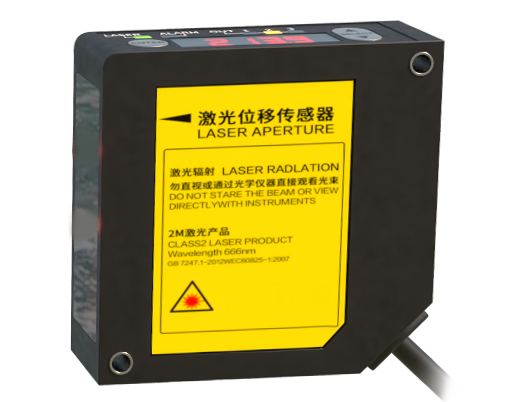
Industrial laser sensors primarily provide two types of output signals: analog and digital. Analog outputs, such as 0-10V or 4-20mA, offer continuous data representing parameters like light intensity or position offset. They are ideal for applications requiring proportional control or precise measurement, such as edge detection in web guiding or thickness monitoring. Digital outputs, including NPN/PNP transistor switches or serial communication protocols (RS-485, IO-Link), provide discrete on/off signals or packaged digital data. These are commonly used for presence detection, part counting, or triggering subsequent actions in an assembly line. The choice between analog and digital depends on the required resolution, response speed, and integration complexity.
Signal integrity is paramount. Several factors can degrade the laser receiver's signal. Ambient light interference, especially from high-intensity sources like sunlight or welding arcs, can saturate the sensor or create false triggers. Electrical noise from motors, drives, or radio frequency interference (RFI) can couple into the signal lines, distorting the output. Physical contaminants like dust, oil, or condensation on the sensor lens attenuate the laser beam, reducing signal strength. To mitigate these issues, engineers employ various strategies. Optical filters matched to the laser's wavelength (e.g., 650nm red or 905nm infrared) effectively block unwanted ambient light. Proper electrical shielding, twisted-pair cabling, and grounding practices minimize electromagnetic interference. Regular maintenance and protective housings (IP67-rated) keep the lens clean. Additionally, many sensors feature adjustable gain or threshold settings to fine-tune sensitivity for specific conditions.

Advanced signal processing techniques are embedded within modern laser receivers to enhance functionality. Background suppression technology allows the sensor to ignore reflections from distant objects beyond a set range, focusing only on the target. Pulse modulation techniques, where the laser emitter is rapidly switched, enable the receiver to distinguish the laser signal from constant ambient light through synchronous detection. For analog position-sensing receivers (PSDs), algorithms calculate the centroid of the laser spot to determine precise X-Y coordinates, even if the spot is not uniformly intense.
When integrating a laser receiver into a system, careful consideration of several parameters ensures optimal performance. The sensing range must be compatible with the application distance, considering the laser's power and the receiver's sensitivity. Response time, often in the microsecond range, must be faster than the process cycle time. The size of the laser spot and the receiver's active area must align; a small spot requires precise alignment, while a larger area offers more tolerance. For communication, selecting the appropriate interface (discrete, analog, fieldbus) is crucial for seamless PLC integration. Finally, environmental ratings for temperature, vibration, and ingress protection must withstand the operational conditions.
In conclusion, the signal from a laser receiver sensor is the critical link between optical detection and industrial control action. A deep understanding of its generation, types, and potential vulnerabilities allows engineers to select, configure, and maintain these sensors effectively. By addressing challenges like noise, interference, and environmental factors through proper design and signal processing, laser receivers deliver the high precision and reliability that advanced automation systems demand. Their role in enabling non-contact measurement, alignment, and inspection continues to be indispensable across manufacturing, packaging, robotics, and material handling industries.