In the realm of industrial automation and precision measurement, laser sensors have become indispensable tools. Their ability to provide non-contact, high-accuracy measurements makes them ideal for applications ranging from object detection and positioning to thickness gauging and surface inspection. A critical parameter that fundamentally dictates the performance and suitability of a laser sensor for a specific task is its sampling frequency, often expressed in Hertz (Hz). This article delves into the technical intricacies of laser sensor sampling frequency, its impact on system performance, and key considerations for selection in various industrial scenarios.
Sampling frequency, in the context of laser sensors, refers to the number of discrete distance or presence measurements the sensor can take per second. It is the rate at which the sensor's internal processing unit captures data from its optical receiver. A higher sampling frequency translates to a denser stream of data points over time. This parameter is not to be confused with response time, which is the total latency from a physical change occurring to the corresponding output signal being issued; sampling frequency is a core component influencing this response time.
The importance of selecting an appropriate sampling frequency cannot be overstated. It directly influences several key aspects of an application:

1. Measurement Accuracy on Moving Objects: When measuring the position, dimension, or profile of a moving object, a high sampling frequency is paramount. If the sampling rate is too low relative to the object's speed, the sensor may effectively "miss" details or provide an aliased, inaccurate representation. For instance, measuring the diameter of a fast-rotating shaft requires a sampling rate high enough to capture multiple points per revolution to ensure statistical accuracy and detect potential out-of-roundness.
2. System Response Speed: In high-speed automation, such as sorting on a conveyor line or robotic pick-and-place, the control system requires rapid feedback. A sensor with a high sampling frequency can detect changes almost instantaneously, enabling quicker triggering of actuators (like pushers or grippers) and ultimately allowing for higher production line speeds without sacrificing reliability.
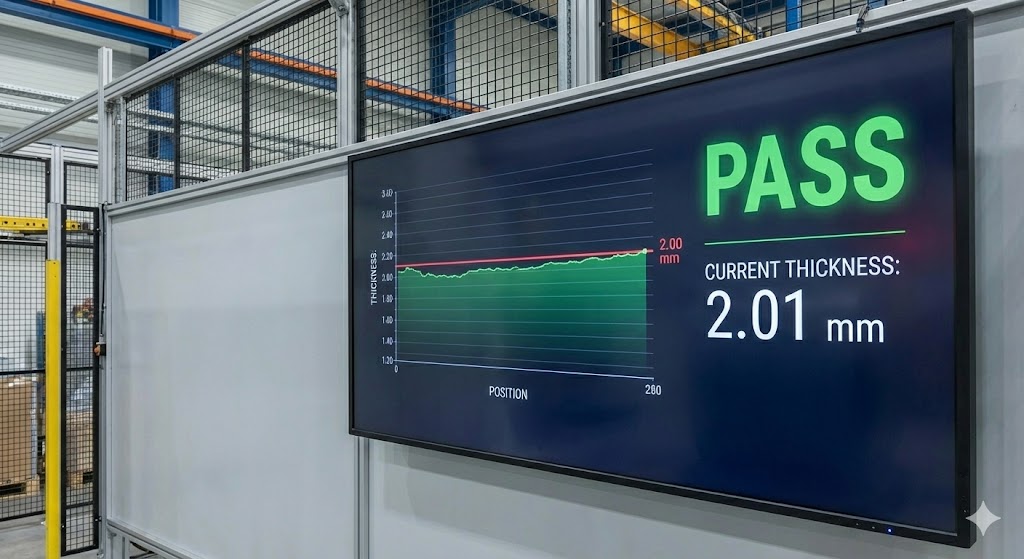
3. Vibration and Noise Immunity: In environments with significant mechanical vibration, a high sampling frequency allows for advanced digital filtering techniques. By taking many samples, the sensor's processor can better distinguish between the actual measurement signal and high-frequency vibrational noise, yielding a more stable and reliable output. A low sampling rate might lock onto noise or produce jittery readings.
4. Data Resolution for Profiling: In 2D/3D profiling or surface contour scanning, the sensor is often scanned across a target. Here, the combination of the sensor's traverse speed and its sampling frequency determines the spatial resolution between consecutive measurement points. A higher sampling frequency at a given scan speed results in a denser point cloud and a more detailed, higher-fidelity profile of the target surface.
However, simply opting for the highest available frequency is not always the optimal engineering decision. Several constraints and trade-offs must be evaluated:
* Processing Power and Data Throughput: A higher sampling rate generates a larger volume of data per second. This demands more from the sensor's internal processor and the subsequent data acquisition system or PLC. It can saturate communication bus bandwidth (e.g., EtherCAT, PROFINET) if not properly specified.
* Sensor Physics and Laser Type: The fundamental technology of the sensor imposes physical limits. For example, the time-of-flight principle for long-range measurements may have inherent limitations compared to triangulation-based sensors for short-range, high-precision tasks. The laser modulation and detection circuitry design dictates the maximum achievable stable sampling rate.
* Power Consumption and Heat Dissipation: Operating at maximum sampling frequency often increases the sensor's power consumption and thermal load, which could be a concern in tightly enclosed panels or power-sensitive applications.
* Cost: Sensors capable of ultra-high sampling frequencies (e.g., 50 kHz, 100 kHz, or more) typically involve more advanced components and processing, reflecting a higher price point.
Selection Guidelines:
For static or very slow-moving object verification, a frequency of 10-100 Hz may be sufficient.
For moderate-speed conveyor sorting or robotic collision detection, frequencies in the 500 Hz to 2 kHz range are common.
For high-speed dimension measurement (e.g., wire, fast-moving webs) or vibration analysis, look for sensors offering 5 kHz to 20 kHz.
For ultra-high-speed applications like ballistic measurement or precise control in semiconductor manufacturing, specialized sensors with frequencies exceeding 50 kHz may be required.
In conclusion, laser sensor sampling frequency is a pivotal specification that bridges the gap between sensor capability and application demand. A thorough analysis of the target object's dynamics, the required system response, and the environmental conditions is essential. By matching the sampling frequency to the specific needs of the task—while respecting the constraints of data handling and system architecture—engineers can unlock the full potential of laser sensing technology, ensuring robust, accurate, and efficient operation in the most demanding industrial environments. Always consult the sensor's datasheet for precise specifications and consider real-world testing under expected conditions for final validation.