In the realm of industrial automation, where reliability, durability, and precision are paramount, inductive proximity sensors stand as a cornerstone technology. These non-contact sensing devices are ubiquitous in manufacturing, packaging, material handling, and countless other sectors. Their fundamental operation is elegantly simple yet robust, based on the principle of electromagnetic induction. At its core, an inductive proximity sensor generates a high-frequency oscillating electromagnetic field via a coil wound around a ferrite core at its active face. When a metallic object—the "target"—enters this field, eddy currents are induced on the target's surface. These eddy currents draw energy from the oscillator circuit within the sensor, causing a measurable change in its amplitude. This change is detected by the sensor's evaluation circuitry, which subsequently triggers a solid-state switching output (typically PNP or NPN). The key characteristic is that only electrically conductive materials, primarily metals, can trigger the sensor. Non-metallic materials like plastic, wood, or liquids are effectively "invisible" to a standard inductive sensor, making them ideal for specific metal-detection tasks.
The advantages of inductive sensors are numerous and explain their widespread adoption. First and foremost is their non-contact nature, which eliminates mechanical wear and tear, ensuring a long operational life even in high-cycle applications. They are exceptionally robust, often housed in stainless steel or nickel-plated brass bodies, making them resistant to shock, vibration, and harsh industrial environments including exposure to coolants, oils, and dust (many conform to IP67 or IP69K ratings). They offer high switching frequencies, capable of detecting thousands of targets per second, which is crucial for high-speed production lines. Furthermore, they are largely immune to ambient light, dirt, and moisture (provided the housing is intact), offering stable and repeatable performance.
Several key specifications define an inductive sensor's performance and suitability for an application. The sensing distance, or nominal range (Sn), is a critical parameter. It is defined for a standard target of mild steel (Fe360). It's crucial to note that the effective sensing distance varies with different metals; for instance, it reduces significantly for stainless steel and aluminum due to their lower permeability and conductivity. Engineers must apply correction factors from manufacturer datasheets. The hysteresis is the difference between the switch-on and switch-off points, which prevents output chatter when a target is at the exact sensing edge. Repeatability indicates the precision with which the sensor can repeatedly detect the same target position. Switching frequency dictates how fast the sensor can respond. Output configuration (e.g., 3-wire DC PNP/NPN, 2-wire AC/DC, analog 4-20mA/0-10V) must be compatible with the controller (PLC). Form factor is also vital, with cylindrical (e.g., M8, M12, M18, M30) and rectangular/block styles being common.
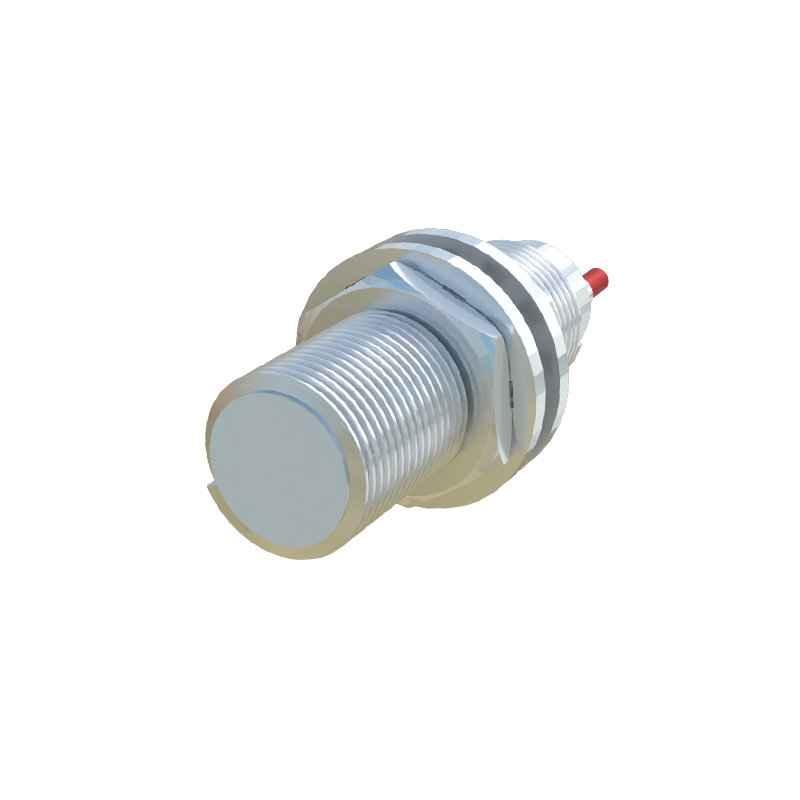
Applications are vast and varied. They are used for position detection: verifying the presence of a metal part in a fixture, checking if a robot gripper is open or closed, or confirming the end position of a cylinder. Counting metal objects on a conveyor is a classic use case. They serve for speed monitoring by detecting gear teeth or holes in a rotating metal disk. In machine tools, they provide end-of-travel limits. Specialized versions, like factor-1 sensors, offer the same sensing distance for all metals, simplifying applications with mixed materials. Cylindrical sensors with threaded barrels allow for easy mounting and precise adjustment.
When selecting an inductive proximity sensor, a systematic approach is essential. Begin by defining the target material and size. The target must be at least as large as the sensor's face for the rated sensing distance. Next, determine the required sensing distance, adding a safety margin (often 20-30%) to account for mechanical tolerances and temperature drift. The environment dictates the housing material and protection rating (IP). Will it be exposed to welding spatter, cutting fluids, or high-pressure washdown? Consider the electrical requirements: supply voltage, output type, and current capacity. Finally, evaluate the physical constraints: available space for mounting often dictates the sensor's shape and size. For challenging environments with heavy metallic dust or when mounting multiple sensors closely, shielded (flush-mountable) variants are preferred as their magnetic field is concentrated in front, minimizing side interference. Unshielded sensors offer a longer range but require more clearance from surrounding metal.
In conclusion, inductive proximity sensors are indispensable workhorses in automation. Their reliability, speed, and resilience make them a first-choice solution for detecting metallic objects without physical contact. A thorough understanding of their operating principles, key specifications, and application