Laser sensors have become integral components across numerous industries, offering unparalleled precision, speed, and reliability for measurement and detection tasks. Unlike conventional sensors, they utilize focused light beams to interact with target objects, enabling non-contact operation critical for delicate or high-speed processes. The core principle involves emitting a laser beam and analyzing the reflected light. Parameters like time-of-flight, phase shift, or triangulation are then calculated to determine distance, presence, or surface characteristics. This fundamental mechanism branches into several distinct sensor types, each optimized for specific applications.
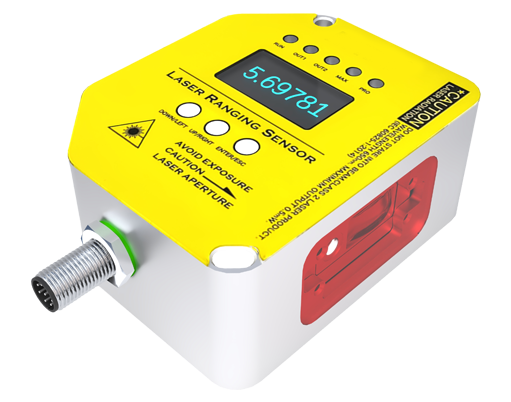
One of the most prevalent categories is the distance measurement sensor. Within this group, Time-of-Flight (ToF) sensors are widely used. They calculate distance by measuring the time it takes for a laser pulse to travel to a target and back. Common in robotics, automotive driver-assistance systems, and warehouse logistics, ToF sensors provide rapid, long-range measurements. Laser triangulation sensors offer higher precision for shorter distances. By projecting a laser spot onto a target and using a receiver at a known angle to detect the spot's position, they excel in profiling, thickness gauging, and 3D scanning. Confocal displacement sensors represent the pinnacle of precision for micron-level measurements, utilizing chromatic aberration to determine distance with extreme accuracy, ideal for semiconductor inspection and transparent material analysis.
Another major category focuses on presence detection and positioning. Through-beam sensors consist of separate transmitter and receiver units. An object is detected when it interrupts the laser beam between them. This setup offers the longest sensing ranges and high reliability, perfect for security systems, industrial automation gates, and object counting on conveyor belts. In contrast, diffuse reflective sensors house both emitter and receiver in a single unit. They detect objects based on the reflection of the laser beam from the target's surface. Their performance depends on the target's color, material, and surface texture, making them suitable for applications like packaging detection and palletizing where the target properties are consistent.
Laser sensors also excel in specialized analytical roles. Laser spectroscopy sensors analyze the spectral composition of light reflected or emitted from a material after laser excitation. They are powerful tools for chemical analysis, environmental monitoring, and pharmaceutical quality control, identifying molecular compositions with high specificity. Vibrometer sensors, based on the Doppler effect, measure velocity and displacement by detecting frequency shifts in the reflected laser beam from a vibrating surface. They are indispensable in structural health monitoring, acoustics research, and precision machinery diagnostics.
The choice of laser sensor depends heavily on the application's demands. For outdoor or challenging industrial environments, factors like housing robustness (often rated IP67 or higher), resistance to ambient light interference, and operating temperature range are critical. Modern sensors increasingly incorporate intelligent features like programmable logic controllers (PLCs), IO-Link communication for parameter setting and diagnostics, and integrated heating for operation in cold conditions.
In manufacturing, laser sensors drive automation and quality assurance. They precisely control robot positioning, verify part dimensions with sub-micron accuracy, and inspect surface defects at high production speeds. The logistics sector relies on them for dimensioning packages, guiding automated guided vehicles (AGVs), and managing inventory through barcode scanning. Emerging fields like autonomous vehicles utilize LiDAR (Light Detection and Ranging), a sophisticated array of laser sensors, to create real-time 3D maps of the surroundings for navigation.
Looking ahead, advancements in laser diode technology, miniaturization, and data processing algorithms continue to push the boundaries. Sensors are becoming smaller, more energy-efficient, and smarter, capable of extracting richer data from their environment. This evolution promises even broader adoption in fields like wearable technology, advanced biomedical instrumentation, and the next generation of smart infrastructure. Understanding the specific types and capabilities of laser sensors is therefore essential for engineers and designers aiming to implement cutting-edge, reliable, and efficient measurement solutions.