In the realm of modern manufacturing, precision is not merely a goal but a fundamental requirement. The integration of laser vision sensor technology into welding processes represents a paradigm shift, enabling unprecedented levels of accuracy, repeatability, and quality control. This article delves into the operational principles, key benefits, and evolving applications of laser vision sensors in welding, providing a comprehensive overview for industry professionals.
At its core, a laser vision sensor for welding is a non-contact measurement system. It typically projects a structured laser line or pattern onto the target workpiece. A high-resolution camera, precisely calibrated and often integrated within the welding torch assembly, captures the deformation of this laser line. Sophisticated software algorithms then analyze this captured image in real-time to extract critical three-dimensional data. This data includes seam tracking information, joint geometry (such as gap width, mismatch, and bevel angle), and post-weld inspection metrics like bead profile and potential defects.
The advantages of deploying laser vision sensors in welding environments are substantial and multifaceted. Firstly, they enable true real-time seam tracking. Unlike pre-programmed robotic paths that assume perfect part placement, vision-guided systems dynamically adapt the welding torch path to accommodate part fit-up variations, thermal distortion during welding, and fixture inaccuracies. This drastically reduces the need for costly and time-consuming fixturing and minimizes scrap rates due to missed joints. Secondly, the technology facilitates adaptive process control. By measuring joint geometry before and during the weld, the system can automatically adjust welding parameters—such as voltage, current, wire feed speed, and travel speed—to maintain optimal weld quality despite variations in gap or mismatch. This is particularly crucial for applications like automotive body-in-white or heavy structural fabrication where consistency is paramount.
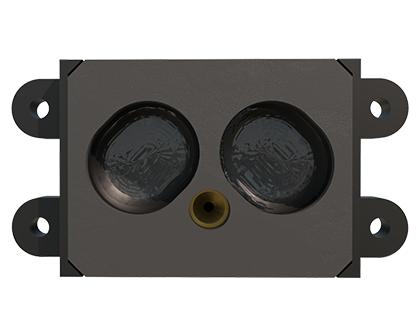
Furthermore, laser vision sensors serve a critical role in quality assurance. Post-weld, the same sensor can scan the completed bead to measure key characteristics: reinforcement height, undercut depth, and bead width. This in-process inspection allows for immediate corrective action, moving quality control upstream in the production line rather than relying solely on final destructive or non-destructive testing. This proactive approach enhances overall equipment effectiveness (OEE) and reduces warranty costs.
The applications for this technology are rapidly expanding across industries. In the automotive sector, laser vision is indispensable for the high-speed, high-volume welding of car bodies, ensuring consistent penetration and appearance on critical safety structures. In heavy industry, such as shipbuilding and construction of wind towers, sensors guide robots along long, complex seams on thick plates, compensating for significant dimensional tolerances. The aerospace industry leverages its precision for welding thin-walled engine components and airframe structures, where any defect is unacceptable. Even in job-shop environments, portable laser vision systems are becoming valuable tools for manual welders to set up and verify joints on large, one-off fabrications.
Looking ahead, the convergence of laser vision sensing with other Industry 4.0 technologies is paving the way for even smarter welding cells. Integration with digital twins allows for virtual commissioning and continuous process optimization. Machine learning algorithms are being trained on vast datasets of sensor readings and weld outcomes to predict and prevent defects before they occur. The evolution towards more compact, robust, and cost-effective sensor packages will further democratize access to this technology, moving it from large OEMs to small and medium-sized enterprises.

In conclusion, laser vision sensor technology has transcended its role as a mere accessory to become a cornerstone of intelligent welding systems. By providing the "eyes" for robotic and automated welding equipment, it delivers the actionable data necessary for closed-loop process control. This not only guarantees weld integrity and compliance with stringent standards but also drives significant gains in productivity, flexibility, and cost-efficiency. As manufacturing demands continue to escalate in complexity, the reliance on such precise, data-driven sensing solutions will only intensify, solidifying their position as an essential tool for the forward-thinking welding engineer.