In the realm of modern industrial automation and quality control, precision laser measurement sensors have emerged as indispensable tools, driving unprecedented levels of accuracy, speed, and reliability. These sophisticated devices utilize laser technology to perform non-contact measurements of distance, displacement, thickness, profile, and even 3D contours with micron-level precision. Their applications span a vast array of sectors, from automotive manufacturing and aerospace to electronics production and semiconductor fabrication.
The core principle behind these sensors often involves triangulation or time-of-flight measurement. In laser triangulation sensors, a laser diode projects a focused spot onto the target surface. The reflected light is captured by a receiving lens at a specific angle and focused onto a position-sensitive detector, such as a CCD or CMOS array. Any change in the target's distance causes a shift in the position of the light spot on the detector, which is then calculated to determine the exact displacement. This method excels in high-speed, high-resolution measurements over short to medium ranges. For longer distances, time-of-flight sensors measure the round-trip time of a laser pulse to calculate distance, offering robust performance in challenging environments.
The advantages of deploying precision laser sensors are manifold. Firstly, their non-contact nature eliminates the risk of damaging delicate surfaces or influencing the measurement through physical force, a critical factor when inspecting soft, hot, or rapidly moving objects. Secondly, they offer exceptional speed, capable of taking thousands of measurements per second, which is essential for in-line process control and 100% inspection on fast production lines. This real-time data acquisition enables immediate feedback and corrective actions, drastically reducing waste and improving yield. Furthermore, their high resolution and repeatability ensure consistent product quality, helping manufacturers adhere to stringent tolerances and international standards.
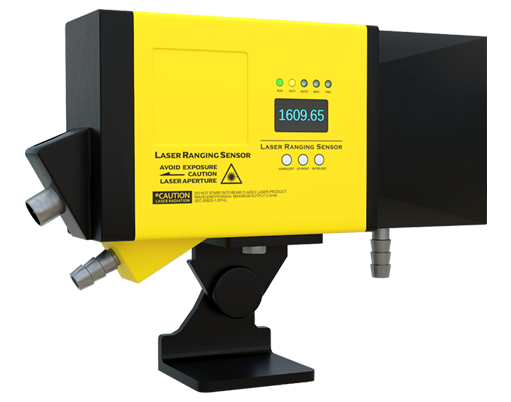
In practical industrial settings, these sensors are the workhorses of precision. In automotive assembly, they verify gap dimensions between body panels, measure weld seam profiles, and inspect part presence with flawless consistency. Within the electronics industry, they are crucial for measuring component height, PCB warpage, and solder paste volume. In roll-to-roll processes for paper, film, or metal, they provide continuous thickness monitoring to maintain product uniformity. Advanced versions, such as laser line profilers, project a laser line instead of a single spot, capturing a complete cross-sectional profile in a single scan. This capability is vital for 3D inspection, surface defect detection, and reverse engineering applications.
Selecting the appropriate laser measurement sensor requires careful consideration of several key parameters. The required measurement range, resolution, and linearity must align with the application's demands. Environmental factors like ambient light, temperature fluctuations, dust, and the target material's surface properties (color, reflectivity, texture) significantly influence sensor performance. Modern sensors often incorporate intelligent features to compensate for these variables, such as automatic exposure control, background suppression, and digital filtering. Integration with industrial networks (Ethernet/IP, PROFINET, EtherCAT) and programmable logic controllers (PLCs) is also a standard expectation, facilitating seamless data flow into manufacturing execution systems (MES) for comprehensive analytics.
The future trajectory of precision laser measurement technology points toward even greater integration, intelligence, and miniaturization. The convergence with artificial intelligence and machine vision is creating "smart sensors" capable of not only capturing data but also interpreting it—identifying complex patterns, predicting trends, and making autonomous decisions. Furthermore, the development of more compact, energy-efficient, and cost-effective models is making this high-precision technology accessible to a broader range of applications, including smaller-scale manufacturing and robotics.
In conclusion, precision laser measurement sensors are far more than mere metrology instruments; they are foundational enablers of Industry 4.0 and smart manufacturing. By providing accurate, reliable, and instantaneous dimensional data, they empower industries to optimize processes, ensure quality, enhance productivity, and maintain a competitive edge in an increasingly demanding global market. Their continued evolution will undoubtedly unlock new possibilities in automation and quality assurance, solidifying their role as a cornerstone of modern industrial engineering.