Laser sensors have become indispensable tools in modern industrial automation, offering unparalleled precision for measurement, detection, and positioning tasks. Their performance is defined by a set of core functional parameters that engineers must thoroughly understand to select the optimal sensor for a specific application. This article delves into these critical specifications, explaining their significance and impact on system performance.
The primary parameter is measurement range, which defines the minimum and maximum distances over which the sensor can operate accurately. This is not merely a physical limit but is intrinsically linked to the sensor's optical design and laser class. Operating outside the specified range leads to signal degradation or complete loss of return signal. Closely related is the reference distance, often the midpoint or a specific point within the range where other parameters like spot size are defined.
Resolution is the smallest change in distance the sensor can detect. It is a measure of its fineness or sensitivity. High-resolution sensors are crucial for applications like wafer alignment or micro-part inspection. It is vital to distinguish resolution from accuracy. Accuracy indicates how close the sensor's reading is to the true value, typically expressed as a percentage of the reading or a fixed value (e.g., ±0.1% of distance or ±50 µm). Accuracy is affected by environmental factors like temperature and target surface properties, whereas resolution is more a function of internal electronics and signal processing.
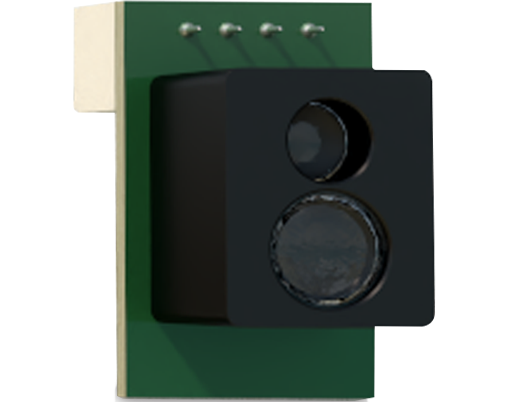
Repeatability, sometimes called precision, is the sensor's ability to consistently return the same measurement for an unchanged target under identical conditions. This is often a tighter specification than accuracy and is paramount in quality control processes where consistency is more critical than absolute true value.
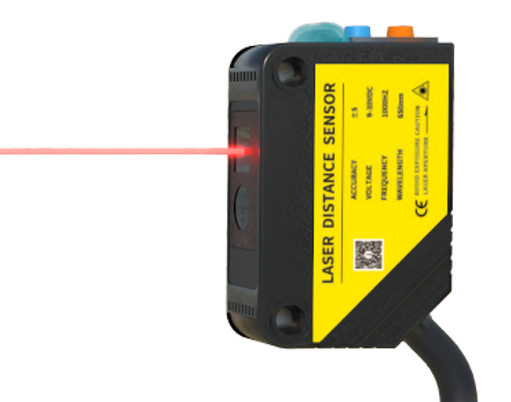
The laser spot size is a critical optical characteristic. It determines the minimum feature size that can be resolved and influences edge detection sharpness. A smaller spot allows for higher lateral resolution but may pose challenges on rough or diffuse surfaces due to speckle patterns. The response time or sampling rate defines how quickly the sensor can take and output a measurement. High-speed applications, such as monitoring moving objects on a conveyor belt, require fast response times (in the microsecond or millisecond range) to avoid motion blur in data.

Linearity error describes the maximum deviation of the sensor's output signal from a best-fit straight line across its entire measurement range. A lower linearity error means the sensor's output is more predictably proportional to the actual distance, simplifying calibration.
The type of measurement principle is a fundamental functional choice. Time-of-Flight (ToF) sensors measure the round-trip time of a laser pulse for long-range applications. Triangulation sensors use a laser, a receiver lens at a known angle, and a position-sensitive detector (PSD or CMOS) for high-accuracy short to medium-range measurements. Confocal chromatic sensors use white light and spectral analysis for nanometer-resolution measurements on reflective or transparent materials.
Environmental ratings are functional necessities. Ingress Protection (IP) rating (e.g., IP67) defines resistance to dust and water. Operating temperature range ensures reliability in harsh environments. Electrical interfaces like analog outputs (0-10V, 4-20mA), digital interfaces (RS-485, Ethernet/IP, PROFINET), and discrete I/O for switching are key for system integration.
Finally, the laser class (Class 1, 2, 2M, 3R) is a safety parameter with functional implications. Class 1 lasers are inherently safe under all conditions, allowing for easier installation in open areas, while higher-class lasers may require additional safety enclosures, affecting the overall system design.
Understanding the interplay of these parameters—range, resolution, accuracy, repeatability, spot size, speed, and environmental robustness—enables engineers to make informed decisions. For instance, a high-speed bottling line prioritizes fast response time and high repeatability, while a laboratory measuring material thickness demands extreme accuracy and resolution. By meticulously matching these functional parameters to application requirements, engineers can unlock the full potential of laser sensing technology, enhancing automation, quality, and efficiency across countless industries from automotive manufacturing to semiconductor fabrication.