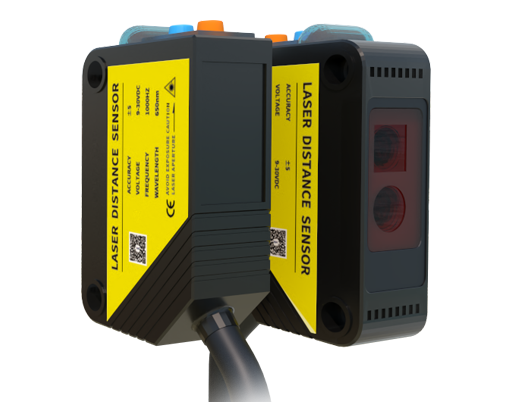
Laser temperature sensors represent a significant advancement in non-contact measurement technology, enabling precise distance calculations by analyzing thermal radiation. Unlike traditional contact methods, these devices operate remotely, making them ideal for hazardous environments, moving objects, or delicate materials where physical probes are impractical. The core principle involves emitting a laser beam toward a target and detecting the infrared energy reflected or emitted based on the target's temperature. This data is then processed to determine distance through sophisticated algorithms that account for factors like emissivity and environmental interference.
The measurement process begins with the sensor's laser diode projecting a focused beam onto a surface. As the beam interacts with the target, the sensor's detector captures the infrared radiation, which correlates directly with temperature. Since the intensity of this radiation diminishes predictably over distance, the sensor can compute the gap between itself and the target. Advanced models integrate time-of-flight or phase-shift techniques, where the laser pulse's travel time or phase change is measured to enhance accuracy. For instance, in industrial settings, this allows monitoring of conveyor belt items or machinery parts without disruption.
Key advantages include high-speed readings, often in milliseconds, and minimal maintenance due to the absence of moving parts. Applications span diverse fields: in manufacturing, they ensure quality control by measuring component positions; in automotive testing, they assess brake system heat distribution; in environmental science, they track geological shifts or forest canopy heights. However, challenges like atmospheric absorption, surface reflectivity variations, and extreme temperatures can affect performance. Calibration against known references and using sensors with adjustable emissivity settings mitigate these issues.
Future developments focus on improving resolution and integrating artificial intelligence for real-time data analysis. As industries prioritize automation and safety, laser temperature sensors are poised to become indispensable tools for accurate, reliable distance measurement in dynamic conditions.