Emissive laser sensors represent a cornerstone technology in modern industrial automation, offering unparalleled precision, reliability, and versatility for a wide range of measurement and detection tasks. Unlike passive sensors that rely on ambient light or emitted radiation from the target itself, emissive laser sensors actively project a controlled laser beam onto an object. The sensor then analyzes the properties of the reflected or scattered light—such as intensity, phase shift, or time-of-flight—to derive critical information about the target's presence, distance, position, thickness, or surface characteristics.
The core operating principle often hinges on triangulation or time-of-flight (ToF) methods. In triangulation-based sensors, a laser diode emits a focused beam that strikes the target surface. The reflected light is captured by a receiving lens at a known angle and focused onto a position-sensitive detector (PSD) or a CMOS/CCD array. Any change in the target's distance causes a measurable shift in the light spot's position on the detector, enabling highly accurate distance measurement. This method is exceptionally effective for short to medium ranges with high resolution. Conversely, ToF sensors calculate distance by measuring the time interval between the emission of a laser pulse and the reception of its reflection. This technology is ideal for longer ranges and is widely used in applications like level sensing in large silos or vehicle detection.
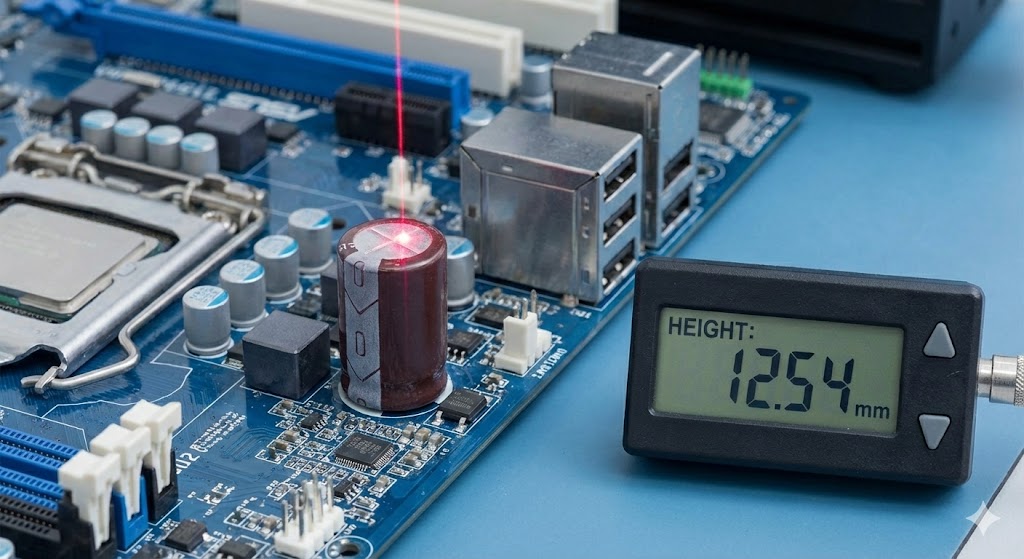
The advantages of integrating emissive laser sensors into industrial systems are manifold. Their primary strength lies in exceptional accuracy and repeatability, often down to the micrometer level, which is crucial for quality control in manufacturing. They provide non-contact measurement, eliminating mechanical wear and allowing inspection of delicate, hot, or moving objects without physical interference. The focused laser beam enables precise detection of small objects or edges, even in challenging environments with background optical noise, as they typically operate on a specific wavelength. Furthermore, their high response speed facilitates real-time process control in high-speed production lines, such as in automotive assembly or electronics manufacturing.
Typical applications span numerous sectors. In factory automation, they are indispensable for precise object detection on conveyor belts, robotic guidance and positioning, and weld seam tracking. The packaging industry relies on them for fill-level control, label placement verification, and counting. In metallurgy and plastics, they measure thickness, width, and surface defects. Furthermore, they play a vital role in safety systems, forming the basis of laser scanners that create protective fields around hazardous machinery.
Selecting the appropriate emissive laser sensor requires careful consideration of several parameters. The required measurement range and resolution dictate the choice between triangulation and ToF principles. The environmental conditions are paramount; factors like dust, steam, vibration, or ambient light interference may necessitate sensors with robust housings (often IP67 or higher), specific laser classes for safety, and built-in filtering algorithms. The target's properties—such as color, material, and surface finish (e.g., shiny, matte, transparent)—significantly affect the reflectivity and must be accounted for, sometimes requiring sensors with automatic exposure control or background suppression. Output signals (analog, digital, IO-Link, Ethernet) must be compatible with the existing control architecture.
Looking ahead, the evolution of emissive laser sensor technology is geared towards enhanced intelligence and miniaturization. The integration of advanced onboard processors and IO-Link communication allows for smarter sensors that can perform preliminary data analysis, self-diagnosis, and parameter configuration directly from the controller. Miniaturization trends are enabling their deployment in increasingly compact machinery and consumer electronics. Furthermore, the development of novel laser sources and detection algorithms continues to push the boundaries of speed, accuracy, and robustness, solidifying their role as an essential component in the advancement of Industry 4.0 and smart manufacturing ecosystems. Their ability to deliver exact, reliable data under tough conditions makes them an irreplaceable tool for engineers striving for efficiency, quality, and automation excellence.