In the realm of industrial automation, robotics, construction, and countless other technical fields, precise distance measurement is a fundamental requirement. Among the various technologies available, laser distance sensors have emerged as a dominant solution, prized for their exceptional accuracy, speed, and versatility. This article delves into the operational principles, key specifications, diverse applications, and critical selection criteria for these sophisticated devices, providing a comprehensive guide for engineers and technical professionals.
At its core, a laser distance sensor operates on the principle of time-of-flight (ToF) or phase-shift measurement. In the common ToF method, the sensor emits a short, focused pulse of laser light towards a target. The light reflects off the target's surface and returns to a receiver within the sensor. An internal high-speed clock precisely measures the elapsed time between emission and reception. Since the speed of light is a known constant, the sensor's processor can calculate the distance to the target with remarkable accuracy using the formula: Distance = (Speed of Light × Time of Flight) / 2. Phase-shift sensors, often used for shorter ranges with higher precision, modulate the amplitude of the laser beam. They measure the phase difference between the emitted and reflected modulated signal to determine distance.
Key performance specifications define a laser sensor's capabilities and suitability for an application. Measuring Range is the minimum and maximum distance over which the sensor can operate reliably, varying from a few centimeters to several hundred meters. Accuracy and Resolution are often confused but distinct. Accuracy refers to the maximum deviation between the measured value and the true distance, typically stated as ±X mm. Resolution is the smallest change in distance the sensor can detect. Repeatability indicates the sensor's consistency in returning the same value for a static target under identical conditions. Response Time or measurement rate, often in Hertz (Hz), determines how quickly the sensor can take and output measurements, a critical factor in high-speed automation. Laser Class (typically Class 1 or 2 for industrial sensors) denotes safety levels, with Class 1 being inherently safe under all conditions of normal use.
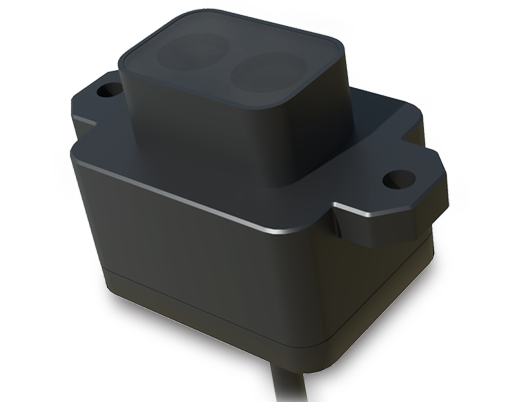
The applications for laser distance sensors are vast and growing. In factory automation, they are indispensable for object detection, positioning robots, controlling material levels in silos, and measuring part dimensions for quality control. Autonomous Mobile Robots (AMRs) and AGVs rely on them for navigation, obstacle avoidance, and docking. The construction industry utilizes handheld laser distance meters and integrated sensors in tools for tasks like area calculation, leveling, and monitoring structural deformation. In logistics, they measure parcel dimensions for automated sorting and pricing. Emerging fields like agriculture use them for crop monitoring and guidance of autonomous machinery.
Selecting the right laser distance sensor requires a careful analysis of the application's demands. First, define the required measuring range and the desired accuracy. Consider the target properties: a dark, matte, or highly reflective surface can absorb or scatter laser light, potentially reducing signal strength and reliability. Some sensors feature advanced algorithms or multiple echo processing to handle difficult surfaces. The environmental conditions are paramount. Dust, fog, steam, or extreme ambient light can interfere with the laser beam. Sensors with higher laser power or specialized optical filters may be necessary for harsh industrial settings. Physical constraints like available mounting space and the required output interface (analog 4-20mA/0-10V, digital RS-232/RS-485, Ethernet, or fieldbus protocols like PROFINET or EtherNet/IP) must align with the control system. Finally, consider form factor, ingress protection (IP) rating for dust and water resistance, and overall robustness.

In conclusion, laser distance sensors offer a powerful, non-contact solution for precise ranging. Their integration into modern industrial systems drives efficiency, quality, and automation. By thoroughly understanding the technology's principles and meticulously matching sensor specifications to the specific application challenges—target characteristics, environmental factors, and performance needs—engineers can leverage these tools to build smarter, more responsive, and more reliable systems. As technology advances, we can expect even smaller, faster, and more intelligent laser sensors to continue pushing the boundaries of what is measurable and automatable.