In the realm of industrial automation and control systems, the M8 proximity sensor with an NPN normally open (NO) configuration stands as a fundamental and highly reliable component. This compact, cylindrical inductive sensor is engineered to detect the presence or absence of metallic objects without physical contact, making it indispensable for tasks like position sensing, counting, and end-of-travel detection in machinery. Its M8 form factor refers to an 8mm diameter threaded barrel, offering a robust and space-efficient design suitable for confined installations.
The operational principle of an inductive M8 proximity sensor is based on electromagnetic induction. The sensor's face generates a high-frequency oscillating electromagnetic field. When a ferrous or non-ferrous metal target enters this detection field, eddy currents are induced within the target, causing a change in the oscillation amplitude. This change is processed by the internal circuitry, triggering a switching action. In the NPN normally open variant, the output switching transistor is of NPN type. In its default state with no target present, the output signal line is in a high-impedance state (effectively "open" or off). When a target is detected within the specified sensing range—typically up to 2mm for standard M8 models—the NPN transistor saturates, connecting the output signal line to the common (0V) line, thus closing the switch and providing a low signal to the connected controller like a PLC.
The choice of NPN (sinking) output and a normally open configuration is dictated by the prevailing control logic in many regions and applications. NPN sensors are commonly used in systems where the load (e.g., PLC input module) is connected between the sensor's output and the positive supply voltage (+V). The normally open function is intuitive: the circuit is completed (switches "on") only upon detection, which often aligns with "active" or "event-triggered" logic in programming. This setup enhances safety in certain scenarios, as a wire break or power loss typically results in a non-detection state.
Key technical specifications for an M8 NPN NO proximity sensor include its sensing distance, rated operational voltage (commonly 10-30V DC), output current capacity, switching frequency, housing material (often nickel-plated brass or stainless steel), and protection ratings like IP67, which guarantees resistance to dust and temporary immersion, crucial for harsh industrial environments. Proper installation is critical; ensuring the correct polarity, maintaining the recommended lateral and axial clearance from metal mounting surfaces to prevent false triggering, and using appropriate fasteners are essential steps.
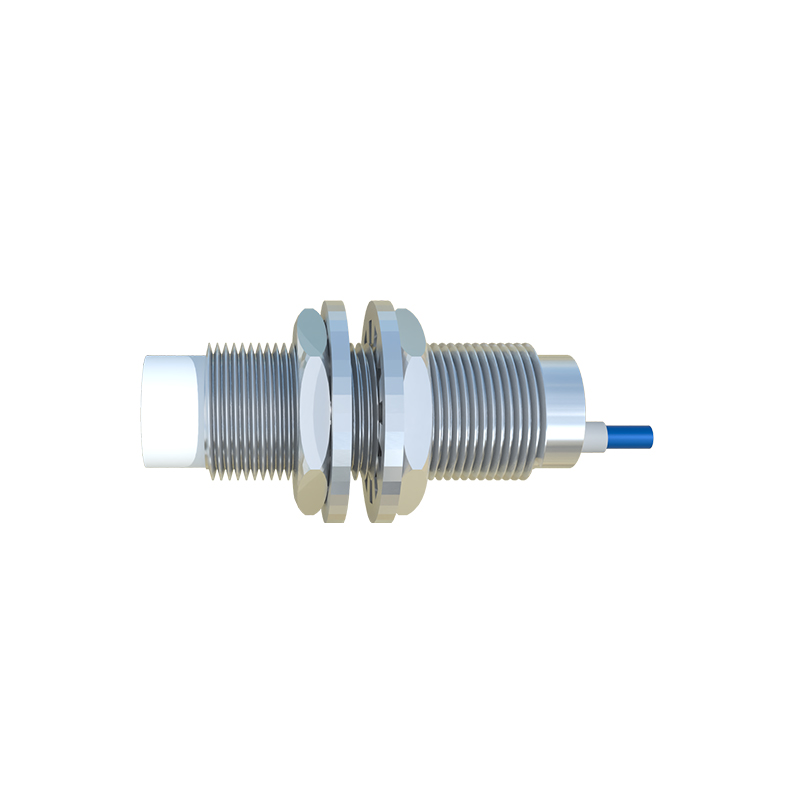
When integrating this sensor, one must carefully design the interface circuit. For an NPN NO sensor, the PLC digital input module should be configured for sinking input. A typical wiring diagram involves connecting the brown wire to +V DC, the blue wire to 0V DC, and the black output wire to the PLC input terminal. A pull-up resistor might be required in some controller interfaces to ensure a clean signal. Troubleshooting common issues often involves checking power supply stability, verifying the target material and size are within specifications, and inspecting for accumulated metallic debris on the sensor face.
Compared to PNP (sourcing) or normally closed (NC) versions, the M8 NPN NO sensor offers a specific solution tailored for control systems designed around negative switching logic. Its durability, high switching speed, and immunity to environmental contaminants like oil and coolant make it a preferred choice in packaging, material handling, automotive assembly, and CNC machine tools. Selecting the right sensor involves a clear understanding of the machine's electrical architecture, the nature of the target, environmental conditions, and the required logic state for safety and operation. The M8 NPN normally open proximity sensor, through its simplicity and robustness, continues to be a cornerstone in building efficient and reliable automated systems.