Laser sensors are integral to modern industrial automation, offering high precision, non-contact measurement capabilities. Understanding how to calculate laser sensor measurements is essential for engineers to ensure accuracy in applications such as distance sensing, object detection, and quality control. This article provides a comprehensive guide to the key calculations involved, based on principles like time-of-flight (ToF), triangulation, and phase-shift analysis.
First, consider the fundamental calculation for time-of-flight laser sensors. These sensors measure distance by calculating the time it takes for a laser pulse to travel to a target and back. The formula is straightforward: Distance = (Speed of Light × Time) / 2. Here, the speed of light is approximately 3×10^8 meters per second, and time is measured in seconds. For example, if the round-trip time is 10 nanoseconds (10×10^-9 seconds), the distance to the target is (3×10^8 × 10×10^-9) / 2 = 1.5 meters. Engineers must account for factors like signal noise and environmental conditions, which can affect time measurement accuracy. Calibration using known reference points is often necessary to minimize errors.
Next, triangulation-based laser sensors are common for precise displacement measurements. In this method, a laser beam is projected onto a target, and the reflected light is captured by a detector at a known angle. The distance calculation relies on geometric principles. If the baseline distance between the laser emitter and detector is 'b', the angle of emission is 'α', and the angle of reflection detected is 'β', the distance 'd' to the target can be derived using the formula: d = b × sin(β) / sin(α + β). This approach is highly effective for short-range applications, such as measuring surface profiles or thickness in manufacturing. Engineers should ensure proper alignment and consider surface reflectivity, as dark or shiny materials can impact the reflected signal strength.
Phase-shift analysis is another technique used in laser sensors, particularly for interferometric measurements. It involves modulating the laser beam and comparing the phase difference between the emitted and reflected signals. The distance is calculated as: Distance = (Phase Shift × Wavelength) / (4π). Here, the wavelength is determined by the laser source, and the phase shift is measured in radians. This method offers sub-micrometer accuracy but requires stable conditions to avoid phase ambiguity. For instance, in semiconductor inspection, engineers use this to measure minute displacements.
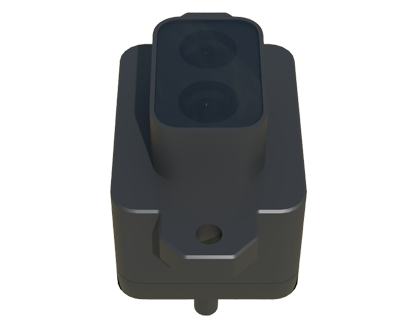
In practice, calculating laser sensor outputs often involves integrating these formulas with sensor-specific parameters. Many modern laser sensors provide digital outputs, where internal processors handle raw calculations. However, engineers must still verify results by considering variables like temperature, which can affect laser wavelength and detector response. For example, in outdoor applications, thermal expansion might alter sensor alignment, leading to drift. Regular maintenance and software corrections, such as using lookup tables or algorithms for environmental compensation, are crucial.
Additionally, signal processing plays a key role in accurate calculations. Laser sensors generate analog signals that are converted to digital data. Engineers apply filters, such as moving averages or Kalman filters, to reduce noise and enhance measurement reliability. For high-speed applications, like monitoring conveyor belt objects, calculation speed is critical; thus, optimized algorithms are used to process data in real-time without lag.
Finally, validation through testing is essential. Engineers should compare laser sensor readings with reference instruments, like calipers or coordinate measuring machines, to ensure calculations align with real-world values. Documenting uncertainty budgets—factoring in elements like resolution, linearity, and repeatability—helps in assessing overall system accuracy. By mastering these calculations, engineers can deploy laser sensors effectively across industries, from automotive assembly to robotics, driving efficiency and precision in automated processes.
