Laser sensors are critical components in industrial automation, quality control, and precision measurement systems. A common yet perplexing issue encountered by engineers is when a laser sensor fails to emit its characteristic beam of light. This absence of visible or infrared laser output can halt production lines, compromise safety systems, and lead to significant downtime. Understanding the root causes requires a systematic approach, examining the sensor's internal components, external conditions, and operational parameters.
The primary cause often lies within the laser diode itself. Laser diodes, the core light-emitting elements, have a finite lifespan and can degrade over time due to factors like excessive operating current, thermal stress, or electrostatic discharge (ESD). Continuous operation beyond the manufacturer's specified current and temperature ratings accelerates aging, leading to a gradual reduction in output power until the diode fails completely. A sudden failure, resulting in no light emission, can occur from a catastrophic event such as a voltage spike or physical shock damaging the diode's semiconductor junction.
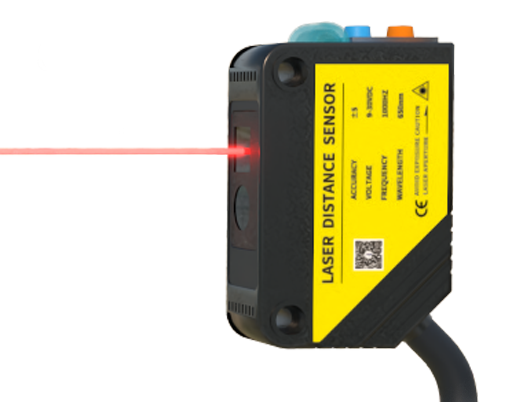
Power supply issues are another frequent culprit. Laser sensors require a stable, clean DC power source within a specified voltage range (commonly 12-24V DC). An unstable power supply, voltage fluctuations below the minimum threshold, or incorrect polarity connection can prevent the sensor's internal circuitry from activating the laser diode. Engineers should first verify the input voltage at the sensor's terminals using a multimeter, ensuring it matches the sensor's nameplate specifications. Additionally, check for proper grounding, as poor grounding can introduce noise that interferes with the sensor's operation.
The sensor's control and driver circuitry play a crucial role. Modern laser sensors often incorporate sophisticated driver circuits that regulate current to the laser diode. A failure in this circuitry—such as a blown fuse, a damaged capacitor, or a faulty transistor—can interrupt the power path to the diode. Some sensors feature built-in protection mechanisms that disable the laser output if an internal fault is detected, such as an over-temperature condition or a short circuit. In such cases, consulting the sensor's diagnostic indicators (like LED status lights) or using manufacturer-specific software for error code retrieval is essential.
External environmental factors cannot be overlooked. Contamination is a major enemy. Accumulation of dust, oil, coolant, or other particulates on the sensor's front lens or output window can completely block the laser beam, making it appear as if no light is emitted. In harsh industrial environments, this is a common occurrence. Regular cleaning of the optical surface with appropriate, lint-free materials and approved solvents is a necessary maintenance task. Furthermore, extreme ambient temperatures outside the sensor's operating range can cause internal components to malfunction. Condensation forming inside the housing due to rapid temperature changes or high humidity can also short-circuit electronics or fog the optics.

Configuration and wiring errors are simple but often overlooked causes. Many programmable laser sensors have configurable output modes. An inadvertent setting that disables the continuous laser emission (e.g., setting it to a "power save" mode where the laser only pulses during measurement) can be mistaken for a failure. Verifying the configuration via the sensor's teach-in button or software interface is a critical step. Similarly, incorrect wiring of the output signal lines or a fault in the connected controller (PLC) can create a logical condition that inhibits laser activation, even if the sensor itself is functionally sound.
Troubleshooting should follow a logical sequence. Start with the simplest checks: confirm power is present and correct, inspect for physical damage or contamination, and verify basic configuration settings. Next, use diagnostic tools. An infrared viewer card is invaluable for detecting infrared laser beams invisible to the naked eye. A optical power meter can quantitatively measure the output, distinguishing between a completely dead diode and one with severely degraded output. If the sensor has communication capabilities (e.g., IO-Link), connecting to it can provide detailed internal status and error logs.
Preventive maintenance is key to avoiding unexpected failures. Implement scheduled inspections to clean optical components, ensure stable power and grounding, and monitor operating temperatures. Adhere to the manufacturer's guidelines for maximum operating current and duty cycle. When replacing a laser diode or the entire sensor, ensure electrostatic discharge (ESD) precautions are strictly followed during handling and installation.
In conclusion, a laser sensor not emitting light is a symptom with multiple potential diagnoses, ranging from a depleted laser diode and power irregularities to environmental contamination and configuration mistakes. A methodical troubleshooting approach, combining visual inspection, electrical measurement, and utilization of available diagnostics, allows engineers to efficiently identify and resolve the issue, restoring system functionality and minimizing costly operational interruptions.