In the rapidly evolving landscape of industrial automation and precision measurement, the physical size of laser displacement sensors has become a critical factor influencing their application and integration. This article delves into the principles, trends, and implications of sensor miniaturization, providing insights for engineers and system designers.
The core technology enabling compact laser displacement sensors lies in advancements in optical components, semiconductor lasers, and integrated circuitry. Traditional sensors often relied on bulky laser diodes and complex optical paths, requiring significant housing space. Modern designs utilize high-efficiency, low-power VCSELs (Vertical-Cavity Surface-Emitting Lasers) and micro-optics, which drastically reduce the footprint. The integration of CMOS or CCD imaging sensors and sophisticated ASICs (Application-Specific Integrated Circuits) for signal processing further consolidates functionality into smaller packages. This miniaturization does not typically compromise performance; instead, it often enhances measurement speed, resolution, and reliability due to reduced thermal drift and improved structural stability.
A key driver for smaller sensor volumes is the demand for integration into confined spaces within automated machinery, robotic arms, and portable inspection devices. In electronics assembly, for instance, sensors must fit into tight spaces on pick-and-place machines to measure component height or coplanarity. Similarly, in automotive manufacturing, compact sensors are mounted on robot end-effectors for inline inspection of body panel gaps or weld seam profiles. The reduction in size and weight also minimizes inertia, allowing for higher-speed scanning and more dynamic movement in robotic applications without sacrificing accuracy.

The design philosophy extends beyond mere size reduction. Engineers focus on optimizing the form factor—the relationship between the sensor's dimensions and its functional layout. A low-profile, rectangular or cylindrical housing is common, with careful consideration given to the placement of the laser emission window, receiver lens, and connection ports (typically M8 or M12 connectors). This ensures easy mounting and alignment in multi-sensor arrays or complex fixtures. Thermal management is paramount; despite smaller volumes, effective heat dissipation through materials like aluminum alloys and intelligent power management circuits prevents overheating, which could cause measurement drift.
Another significant aspect is the evolution of communication interfaces. Modern compact sensors increasingly support industrial Ethernet protocols like EtherCAT or PROFINET, alongside traditional analog and digital I/O. This connectivity is packed into the same small housing, reducing the need for external interface boxes and simplifying cabling. This integration contributes to a smaller overall system footprint in control cabinets and on machinery.
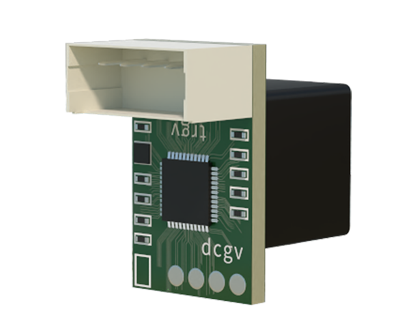
However, miniaturization presents challenges. Shorter optical baselines (the distance between the laser emitter and receiver) can theoretically affect triangulation accuracy for certain measurement principles. Manufacturers counter this by employing advanced algorithms for lens distortion correction and sub-pixel interpolation. Furthermore, robust housing designs that meet IP67 or higher ingress protection ratings are essential to protect delicate internal components from dust, coolants, and mechanical shocks in harsh industrial environments, even within a small form factor.
Looking ahead, the trend toward even smaller volumes continues, driven by MEMS (Micro-Electro-Mechanical Systems) technology and system-on-chip solutions. Future sensors may approach the size of a smartphone camera module while offering micrometer-level accuracy. This will unlock new applications in micro-manufacturing, medical devices, and consumer electronics quality control.
In conclusion, the miniaturization of laser displacement sensors represents a sophisticated engineering achievement balancing size, performance, and durability. For professionals selecting sensors, understanding the technological foundations of this compact design is crucial for optimizing machine design, enhancing production flexibility, and future-proofing measurement systems. The small volume is no longer a limitation but a gateway to greater innovation in precision metrology.