Proximity sensors are essential devices in modern industrial automation, providing non-contact detection of objects within a specific range. These sensors are widely used in manufacturing, robotics, automotive assembly, and safety systems due to their reliability, durability, and precision. Understanding the key components of a proximity sensor is crucial for engineers and technicians involved in system design, installation, and maintenance. This article delves into the fundamental parts that constitute a typical proximity sensor, explaining their roles and how they contribute to overall functionality.
At the core of a proximity sensor is the sensing element, which varies depending on the technology employed. The most common types include inductive, capacitive, ultrasonic, and photoelectric sensors. Inductive sensors, for instance, use a coil and oscillator to generate an electromagnetic field. When a metallic object enters this field, eddy currents are induced, causing a change in oscillation amplitude. This change is detected by the sensor’s circuitry, triggering an output signal. Capacitive sensors operate similarly but respond to both metallic and non-metallic materials by detecting changes in capacitance. Ultrasonic sensors emit sound waves and measure the time taken for echoes to return, while photoelectric sensors use light beams to sense object presence. Each sensing element is tailored to specific applications, such as detecting metal parts on a conveyor belt or liquid levels in tanks.
The oscillator circuit is another critical component, particularly in inductive and capacitive sensors. It generates a high-frequency electromagnetic field or electrical oscillations that interact with the target object. In inductive sensors, the oscillator typically operates at frequencies ranging from 100 kHz to 1 MHz, creating a stable field around the sensor’s face. Any disturbance in this field, caused by a metallic object, alters the oscillation. The oscillator’s design ensures sensitivity and stability, allowing the sensor to detect objects accurately even in harsh environments with vibration or temperature fluctuations. For capacitive sensors, the oscillator adjusts based on capacitance changes, enabling detection of materials like plastics, glass, or liquids.
Signal processing circuitry is responsible for interpreting changes detected by the sensing element and oscillator. This component includes amplifiers, comparators, and microcontrollers that convert analog signals into digital outputs. When the sensor identifies an object, the signal processor analyzes the input, filters out noise, and determines whether the object meets the predefined detection criteria. For example, in an inductive sensor, the processor monitors the oscillator’s amplitude drop and activates the output when it exceeds a threshold. Advanced sensors may incorporate programmable logic for adjusting sensitivity, response time, or output modes (e.g., NPN or PNP). This circuitry ensures reliable operation, minimizing false triggers and enhancing system efficiency.
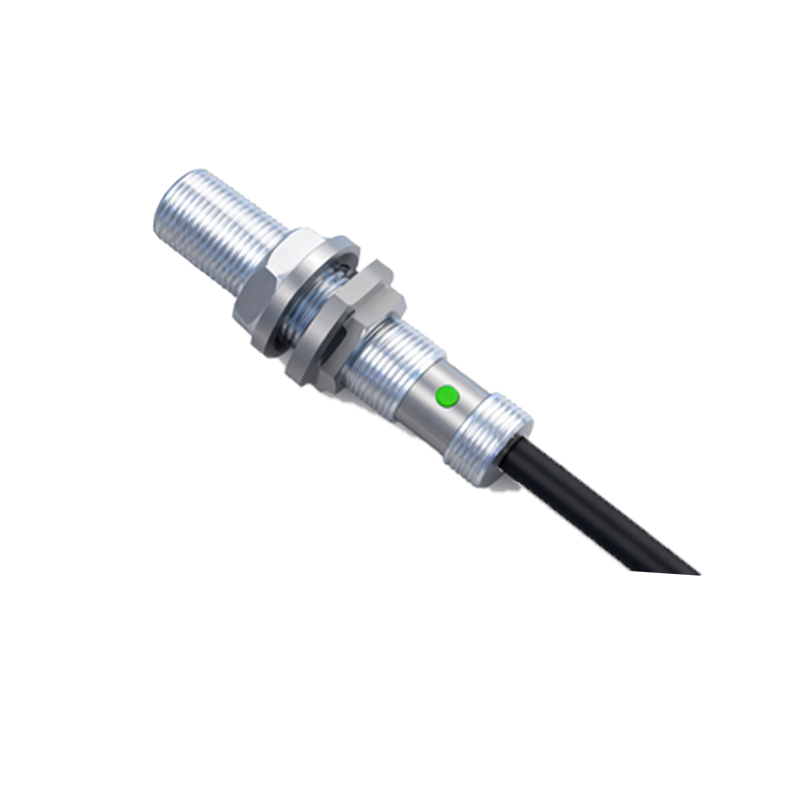
The output stage is the interface between the sensor and external control systems, such as PLCs (Programmable Logic Controllers) or relays. It typically consists of a transistor or solid-state switch that provides a digital signal—either ON or OFF—based on detection events. Common output configurations include NPN (sinking) and PNP (sourcing) transistors, which cater to different electrical standards. Some sensors also offer analog outputs (e.g., 4-20 mA or 0-10 V) for distance measurement applications. The output stage is designed to handle specific voltage and current ratings, often protected against short circuits, overloads, and reverse polarity. This component enables seamless integration into automation networks, allowing for real-time monitoring and control.
Housing and connectors form the physical structure of a proximity sensor, safeguarding internal components from environmental factors. Made from materials like stainless steel, nickel-plated brass, or thermoplastics, the housing provides resistance to moisture, dust, chemicals, and mechanical impact. In industrial settings, sensors may be rated with IP (Ingress Protection) codes, such as IP67 or IP69K, indicating their durability against water and dust ingress. Connectors, often standardized types like M8 or M12, facilitate easy wiring and installation. Proper housing design also influences sensing range and direction, with cylindrical, rectangular, or ring-shaped variants available for different mounting scenarios.
Power supply components regulate the voltage required for sensor operation, typically ranging from 10-30 V DC. They include voltage regulators, filters, and protection circuits to ensure stable performance despite fluctuations in input power. In some sensors, built-in diagnostics or LED indicators are integrated to display status, such as power-on, detection, or fault conditions. These features aid in troubleshooting and maintenance, reducing downtime in production lines.
In summary, a proximity sensor comprises multiple interconnected parts: the sensing element, oscillator circuit, signal processor, output stage, housing, and power supply. Each component plays a vital role in ensuring accurate, non-contact detection across diverse industrial applications. By understanding these elements, engineers can select and deploy sensors effectively, optimizing automation systems for productivity and safety. As technology advances, innovations like IO-Link communication and smart sensors are adding connectivity and data analytics capabilities