In the realm of industrial automation, the synergy between precise sensing technology and robust control systems forms the backbone of modern manufacturing and process control. Among the various sensing solutions available, laser sensors have emerged as a premier choice for non-contact, high-accuracy measurement and detection. When integrated with Programmable Logic Controllers (PLCs), these sensors unlock new levels of efficiency, quality control, and operational intelligence. This article delves into the technical principles, integration methodologies, and practical applications of combining laser sensors with PLC systems.
Laser sensors operate on the principle of emitting a focused beam of light—typically from a laser diode—towards a target object. The sensor then analyzes the reflected light to determine specific parameters such as distance, position, height, thickness, or presence. Common technologies include time-of-flight (ToF), triangulation, and confocal measurement. These methods offer distinct advantages: ToF sensors are excellent for long-range detection, triangulation sensors provide exceptional precision at shorter ranges, and confocal sensors excel in measuring reflective or transparent surfaces. The key attributes of laser sensors include high resolution, often in the micrometer range; fast response times, critical for high-speed production lines; and immunity to environmental factors like ambient light or electromagnetic interference when properly shielded.

The integration of these sophisticated sensors with a PLC involves both hardware interfacing and software programming. On the hardware front, laser sensors typically provide digital outputs (e.g., PNP/NPN switching signals), analog outputs (e.g., 0-10V or 4-20mA proportional to the measured value), or serial communication interfaces (e.g., RS-485, Ethernet/IP, PROFINET). Connecting a sensor with a discrete output to a PLC's digital input module is straightforward, suitable for simple presence detection or go/no-go checks. For applications requiring precise measurement data, an analog output or a fieldbus network connection is essential. Modern laser sensors often support industrial Ethernet protocols, enabling seamless data exchange within a networked PLC architecture, which is central to Industry 4.0 initiatives.
Within the PLC programming environment—such as Siemens TIA Portal, Rockwell Studio 5000, or CODESYS—the engineer must configure the input channels to match the sensor's signal type. For analog inputs, scaling functions are programmed to convert the raw input value (e.g., 0-27648 for a 4-20mA signal) into meaningful engineering units (e.g., millimeters). Logic is then developed to process this data. This can range from simple comparison instructions to trigger an actuator, to complex PID control loops for maintaining a precise position. The PLC program can also implement advanced functions like data logging, trend analysis, and generating alarms for out-of-tolerance conditions. The deterministic scan cycle of the PLC ensures that sensor data is processed and acted upon with predictable timing, a non-negotiable requirement in synchronized automation.
The applications of laser sensor-PLC systems are vast and transformative. In automotive assembly, they are used for robot guidance, ensuring parts are positioned correctly for welding or mounting. In packaging machinery, they measure fill levels, check label placement, and inspect seal integrity with incredible speed. In semiconductor fabrication, they provide the nanometer-level precision required for wafer alignment and thickness verification. In material handling, laser sensors mounted on AGVs (Automated Guided Vehicles) work in concert with a central PLC for navigation and collision avoidance. A quintessential example is a web tension control system in a printing press: a laser sensor continuously measures the position of a dancer roll, sends an analog signal to the PLC, which then adjusts the speed of a drive motor via a variable frequency drive (VFD) to maintain perfect tension, preventing web breaks or misprints.
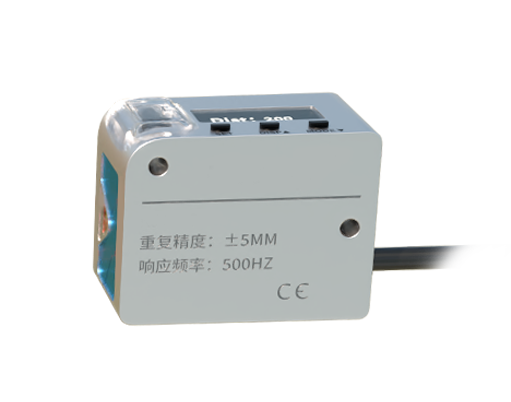
Implementing such a system requires careful consideration. Sensor selection must align with the application's required range, resolution, target surface properties, and environmental conditions (dust, temperature, vibrations). The choice of PLC and its I/O modules must support the necessary data throughput and communication protocols. Electrical noise in industrial settings necessitates proper wiring practices, such as using shielded cables and separate conduits for power and signal lines. Regular maintenance, including lens cleaning for the laser sensor and firmware updates, is crucial for sustained accuracy.
In conclusion, the fusion of laser sensing technology with PLC control represents a powerful paradigm in industrial automation. It moves systems beyond simple binary detection towards intelligent, data-driven operation. This integration enhances product quality through precise measurement, boosts productivity by enabling faster and more reliable processes, and reduces waste by ensuring accuracy from the start. As laser sensors become more intelligent with built-in IO-Link functionality and as PLCs evolve with greater computing power and cloud connectivity, this partnership will continue to be a critical driver for innovation in smart factories and beyond, paving the way for more adaptive, efficient, and autonomous industrial systems.
