In the fast-paced world of industrial manufacturing and logistics, accuracy and efficiency are paramount. The integration of advanced sensing technology into labeling systems has revolutionized how products are identified and tracked. Among these innovations, the laser displacement sensor labeling machine stands out as a critical tool for achieving unparalleled precision in automated packaging lines. This technology represents a significant leap from traditional mechanical or vision-based systems, offering robust performance even in challenging environments.
At its core, a laser displacement sensor labeling machine utilizes a non-contact measurement principle. A laser diode projects a focused beam of light onto the target surface—typically a product or packaging moving on a conveyor belt. The sensor then precisely measures the distance to that surface by analyzing the position of the reflected light spot. This real-time distance data is the key to its functionality. By continuously monitoring the height and position of each item passing beneath the labeling head, the system can make instantaneous adjustments. It calculates the exact moment to dispense the label and controls the applicator's movement to ensure perfect placement, every single time. This is crucial for applications where labels must be applied to specific, often recessed or irregular, areas like electronic components, cosmetic containers, or automotive parts.
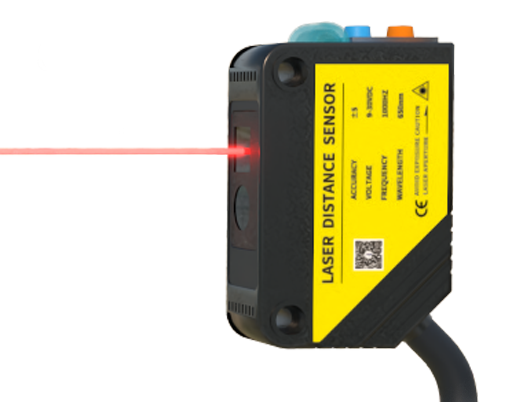
The advantages of employing laser displacement sensors in labeling are multifaceted. First and foremost is precision. Unlike systems that rely on physical guides or less accurate proximity sensors, laser displacement provides micron-level accuracy. This eliminates common issues such as skewed, wrinkled, or misaligned labels, which can lead to production slowdowns, rework, and wasted materials. Secondly, these systems offer remarkable speed and adaptability. They can handle high-throughput production lines without sacrificing accuracy, easily keeping pace with modern manufacturing demands. The sensor's ability to instantly profile different product heights allows for quick changeovers between product batches, minimizing downtime. This flexibility is essential for factories running mixed-SKU production.
Another significant benefit is reliability in diverse conditions. Laser sensors are largely immune to ambient light variations, color contrasts, or surface textures that can confuse traditional optical sensors or cameras. Whether the product surface is glossy, matte, dark, or transparent, the laser displacement sensor consistently delivers accurate distance readings. This robustness translates to fewer system errors and higher overall equipment effectiveness (OEE). Furthermore, the non-contact nature of the measurement means there is no wear and tear on the sensor from touching products, leading to lower maintenance requirements and longer service life.

The applications for laser displacement sensor labeling machines are extensive across numerous industries. In the pharmaceutical sector, they ensure labels are perfectly applied to vials, syringes, and blister packs, which is critical for regulatory compliance and patient safety. In food and beverage, they handle the labeling of bottles, cans, and pouches on high-speed lines, even when containers are wet or have condensation. Electronics manufacturers rely on them for applying precise labels to circuit boards and small devices. The automotive industry uses them for part identification and tracking throughout the supply chain. Essentially, any operation requiring consistent, high-accuracy label placement on variable surfaces can benefit from this technology.
Implementing such a system involves integration with a programmable logic controller (PLC) and the labeling applicator. The sensor feeds continuous positional data to the PLC, which acts as the brain, issuing commands to the label dispenser. Modern machines often feature user-friendly touchscreen interfaces, allowing operators to set parameters, create product recipes, and monitor performance with ease. When selecting a laser displacement sensor labeling machine, key factors to consider include measurement range, repeatability, response speed, and the compatibility of the sensor with the specific environmental conditions of the plant, such as temperature, humidity, and vibration.
In conclusion, the laser displacement sensor labeling machine is more than just an incremental improvement in packaging technology; it is a transformative solution for modern industry. By marrying the pinpoint accuracy of laser metrology with automated labeling, it addresses the core challenges of quality, speed, and flexibility. As industries continue to push for greater automation and smarter manufacturing under the frameworks of Industry 4.0, the role of such intelligent, sensor-driven equipment will only become more central. Investing in this technology is an investment in reducing waste, optimizing production flow, and ensuring a final product that meets the highest standards of presentation and traceability.
