In the realm of high-precision manufacturing and material processing, laser milling stands as a pivotal technology for creating intricate micro-features, surface texturing, and precise component machining. The efficacy and accuracy of this process are fundamentally dependent on one critical component: the depth sensor. Laser milling depth sensors are sophisticated metrological devices designed to measure and control the ablation depth in real-time, ensuring unparalleled precision and repeatability. This article delves into the operational principles, technological advancements, and diverse industrial applications of these sensors, highlighting their indispensable role in modern manufacturing.
At its core, a laser milling depth sensor functions by monitoring the distance between the laser processing head and the workpiece surface, or by directly measuring the depth of the machined cavity. The most prevalent technologies employed are confocal chromatic sensing and low-coherence interferometry. Confocal chromatic sensors utilize a multi-lens optical system and a white light source. Different wavelengths of light are focused at different distances along the measurement axis. Only the wavelength that is precisely focused on the target surface is reflected back through a confocal aperture to a spectrometer, which then determines the exact distance or depth based on the wavelength's peak intensity. This method offers high resolution, often in the sub-micrometer range, and is relatively immune to surface reflectivity variations.
Low-coherence interferometry, another leading technique, leverages the principle of optical interference. A broadband light source with a short coherence length is split into two beams: one directed at the target and the other to a reference mirror. The reflected beams recombine, and interference occurs only when the optical path lengths match within the coherence length. By scanning the reference mirror and analyzing the interference signal, the system can construct a precise depth profile of the milled feature. This technique excels in providing high-accuracy, absolute distance measurements even on rough or diffuse surfaces.
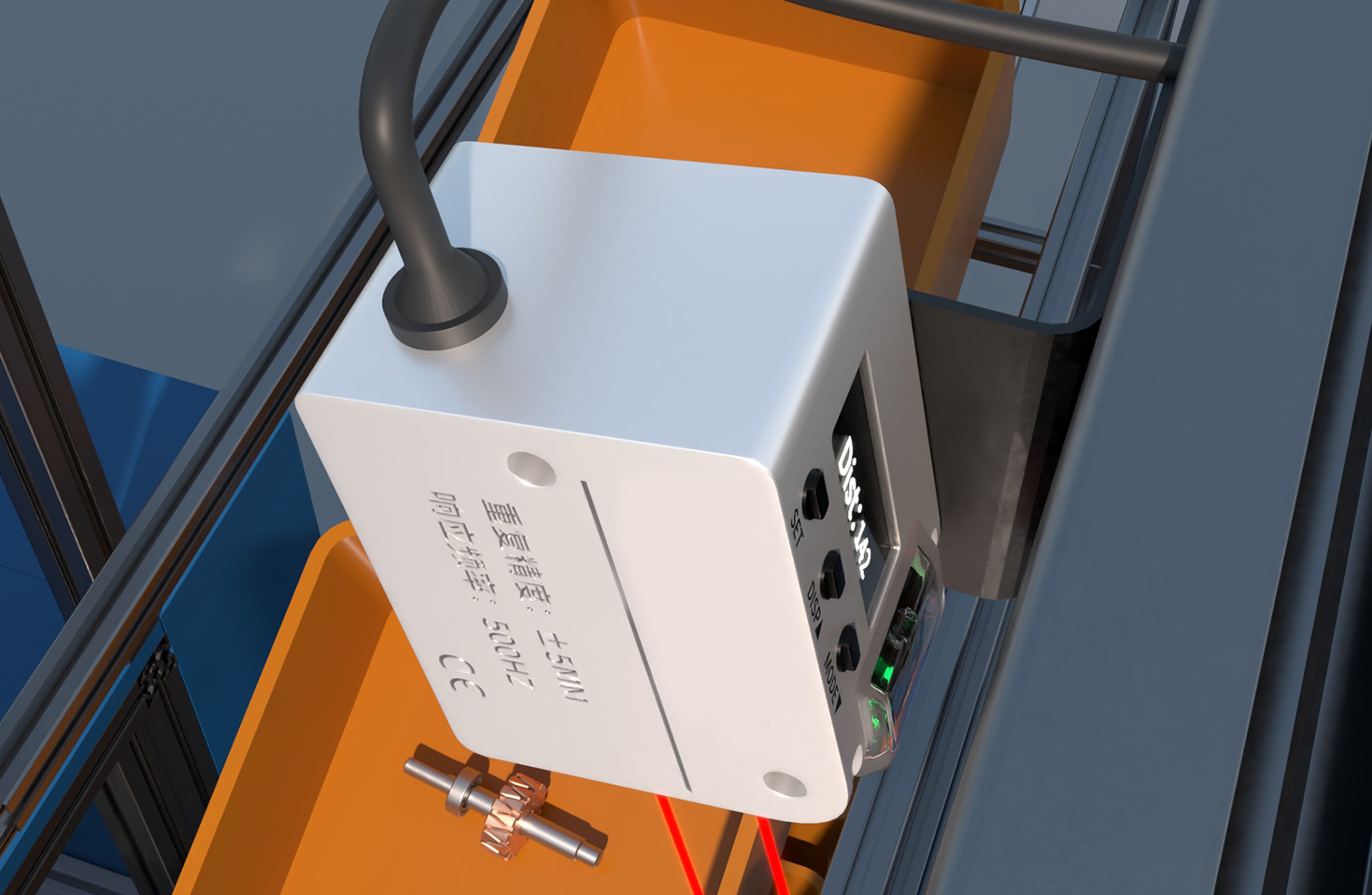
The integration of these sensors into laser milling systems enables closed-loop control, a transformative capability for industrial applications. During the milling process, the sensor continuously feeds depth data to the system's controller. This controller dynamically adjusts laser parameters such as pulse energy, frequency, and scanning speed to compensate for material inhomogeneity, thermal drift, or tool wear. For instance, if the sensor detects that the ablation depth is shallower than the programmed value, the controller can momentarily increase the pulse energy to achieve the desired depth, thereby maintaining consistent quality across the entire workpiece. This real-time feedback loop is crucial for achieving tolerances often required in micro-machining, which can be as tight as a few micrometers.
The applications of laser milling depth sensors span numerous high-tech industries. In the aerospace sector, they are used to manufacture turbine blades with complex cooling channels and precise surface contours, where material integrity and dimensional accuracy are non-negotiable for performance and safety. The medical device industry relies on these sensors for producing implants with tailored surface textures to promote osseointegration or for creating microfluidic channels in lab-on-a-chip devices. In the electronics industry, they facilitate the fabrication of micro-vias in printed circuit boards (PCBs) and the trimming of thin-film resistors to precise values. Furthermore, in the tool and die-making industry, depth sensors ensure the accurate creation of molds and stamps with fine details.
Recent technological advancements are pushing the boundaries of what these sensors can achieve. The integration of high-speed cameras and advanced algorithms allows for in-process monitoring not just of depth, but also of process anomalies like plume formation or melt pool dynamics in additive-subtractive hybrid manufacturing. The development of compact, fiber-optic sensor heads has enhanced their integration flexibility, allowing them to be mounted directly on fast-moving laser scanning galvanometers. Moreover, the advent of machine learning is beginning to play a role, where sensor data is used to train predictive models for process optimization and defect prevention, moving towards truly intelligent laser machining systems.
Despite their sophistication, implementing laser milling depth sensors presents certain challenges. The intense plasma plume and spatter generated during laser ablation can interfere with optical measurements, necessitating effective shielding or purge gas systems. The choice of sensor must also be matched to the specific material's optical properties; highly reflective or transparent materials may require specialized sensor configurations or alternative sensing principles. Additionally, the high initial investment and need for specialized expertise for system integration and calibration can be barriers for smaller workshops.
In conclusion, laser milling depth sensors are far more than simple measuring tools; they are the enablers of precision, consistency, and intelligence in advanced laser material processing. By providing real-time, high-fidelity feedback on the machining process, they form the critical link between digital design intent and physical part realization. As laser milling continues to evolve towards finer features, new materials, and more complex geometries, the role of depth sensing will only grow in importance, solidifying its status as a cornerstone technology for the future of digital manufacturing.