Laser height measurement sensors, also known as laser displacement sensors or laser triangulation sensors, are pivotal components in modern industrial automation and quality control systems. These devices utilize the principle of optical triangulation to determine the distance or height of a target object with exceptional precision. A laser diode projects a focused beam of light onto the target surface. The reflected light is then captured by a receiving lens and focused onto a position-sensitive detector, typically a CCD or CMOS array. The position of the light spot on this detector shifts proportionally to the distance of the target. By calculating this shift, the sensor's internal processor can determine the exact height or displacement with micron-level accuracy.
The advantages of laser height sensors are numerous, making them indispensable across various sectors. Their non-contact nature is paramount, as it eliminates mechanical wear and allows for measurement of delicate, hot, moving, or otherwise inaccessible surfaces without causing damage. High-speed measurement capabilities, often in the kilohertz range, enable real-time inspection on fast-moving production lines, such as in automotive manufacturing for checking panel gaps or in electronics for verifying component placement. Furthermore, they offer high resolution and repeatability, ensuring consistent and reliable data critical for statistical process control.
Key specifications define a sensor's suitability for an application. Measuring range, stand-off distance, spot size, linearity, and resolution are primary considerations. For instance, a sensor with a large measuring range might sacrifice resolution, while a very small spot size is excellent for measuring fine details but may struggle with rough or diffusely reflecting surfaces. The type of laser—typically red visible or Class 2 infrared—also plays a role in visibility and performance under different ambient light conditions.
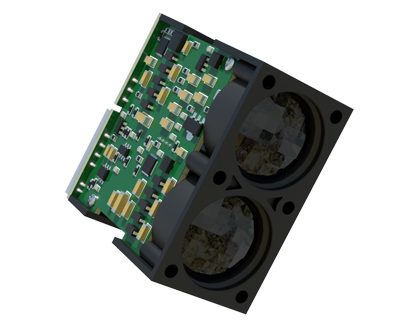
Industrial applications are vast and diverse. In the automotive industry, these sensors are used for robotic guidance, weld seam inspection, and dimensional verification of body parts. In electronics manufacturing, they measure solder paste height, component coplanarity, and PCB warpage. The metal processing industry relies on them for thickness gauging, vibration analysis, and roll gap measurement. Additionally, they are crucial in logistics for pallet profiling and warehouse automation, ensuring efficient use of space.
Selecting the right sensor requires a thorough analysis of the application environment. Factors such as target material, color, surface finish (shiny, matte, transparent), ambient temperature, vibrations, and exposure to dust or coolant must be evaluated. A highly reflective surface can saturate the detector, while a dark, absorptive surface may return too weak a signal. Many modern sensors feature advanced functions like background suppression, multi-peak detection for transparent objects, and digital interfaces (EtherCAT, PROFINET, IO-Link) for seamless integration into industrial networks.
Installation and maintenance are straightforward but crucial for optimal performance. Proper alignment, stable mounting to minimize vibration, and protection from harsh environmental contaminants are essential. Regular calibration checks against a known reference standard help maintain long-term accuracy. As Industry 4.0 advances, these sensors are becoming smarter, with embedded data processing and connectivity features that feed directly into predictive maintenance and big data analytics systems, driving further efficiencies.
In conclusion, laser height measurement sensors are a cornerstone of precision industrial metrology. Their ability to deliver fast, accurate, and reliable non-contact measurements solves complex challenges in automation and quality assurance. As technology evolves, with trends toward miniaturization, higher speeds, and enhanced intelligence, their role in enabling smarter, more flexible, and more efficient manufacturing will only continue to expand. Engineers must carefully match sensor specifications to application demands to fully leverage their transformative potential.