Laser sensors have become indispensable tools across various industries, from manufacturing and logistics to security and automotive applications. Their ability to provide precise, non-contact measurements makes them ideal for countless tasks. However, a common and often challenging scenario involves using a laser sensor to detect objects or measure distances through a transparent barrier, such as glass. This application presents unique physical and technical hurdles that engineers must carefully navigate to ensure reliable system performance.
The core challenge stems from the fundamental interaction between laser light and glass. When a laser beam strikes a glass surface, several optical phenomena occur simultaneously: reflection, refraction, and transmission. A significant portion of the emitted light is reflected off the glass surface back towards the sensor. This strong, direct return signal can saturate the sensor's receiver, effectively blinding it to the weaker signal reflected from the intended target behind the glass. Concurrently, the beam that does enter the glass is refracted, or bent, altering its path. This refraction can introduce measurement errors, as the sensor's calculations typically assume travel through a uniform medium like air. Furthermore, the transmitted beam may encounter the second glass-air interface at the back of the pane, leading to additional internal reflections and further signal degradation. Factors like glass thickness, surface quality (e.g., scratches, coatings), and the angle of incidence all critically influence the magnitude of these effects.
To overcome these challenges, sensor selection and configuration are paramount. Standard time-of-flight or triangulation sensors often struggle in this environment. Engineers frequently turn to specialized sensors with background suppression or true background suppression (TBS) functionality. These sensors are designed to evaluate the spot size or the intensity profile of the returned light, allowing them to intelligently ignore the large, close reflection from the glass surface and instead detect the smaller, diffused reflection from the target object behind it. Adjusting the sensor's sensitivity threshold is also a crucial step; it must be finely tuned to reject the glass reflection while remaining sensitive enough to detect the target.
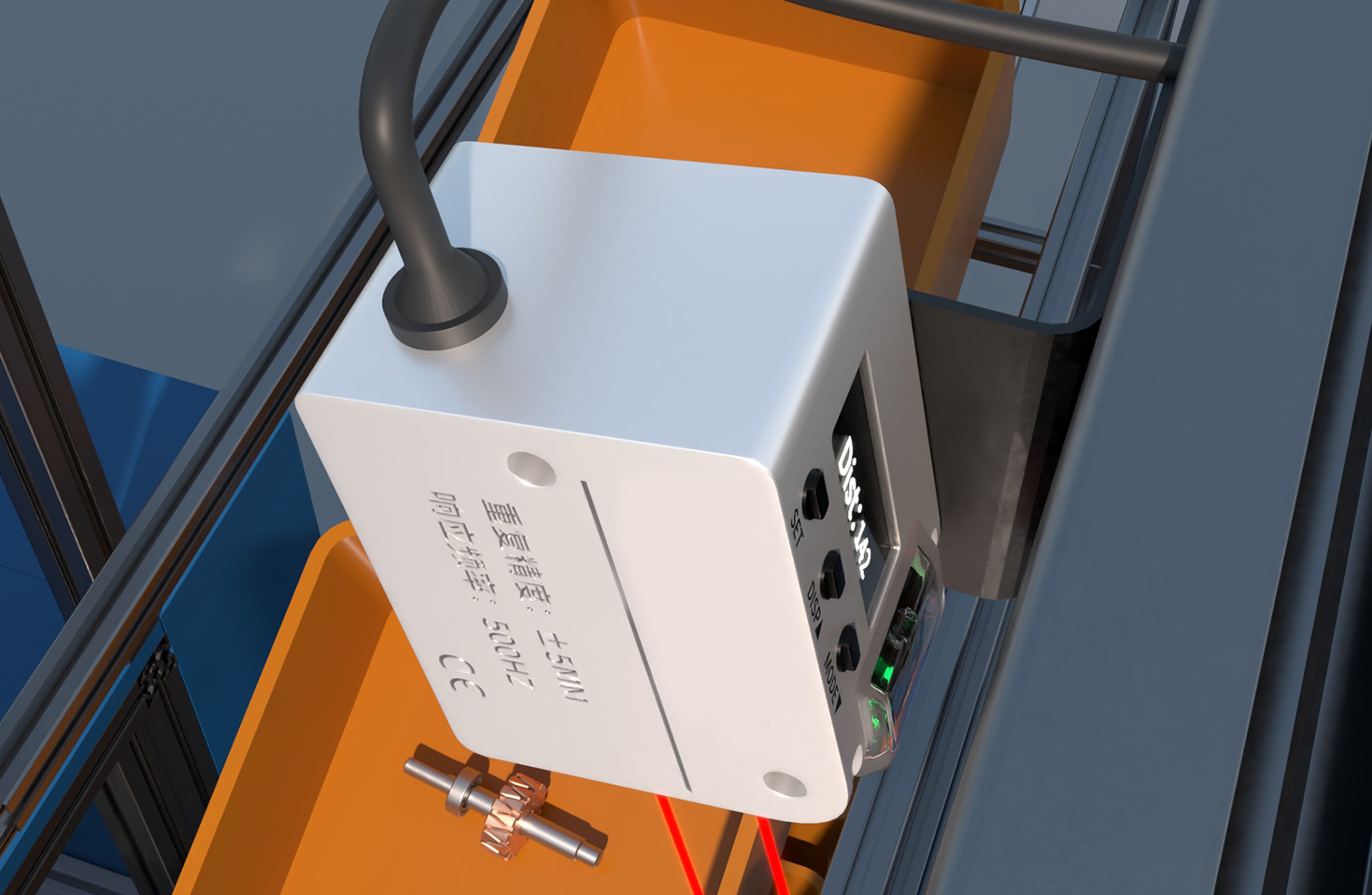
The physical setup plays an equally critical role. Positioning the sensor perpendicular (at a 90-degree angle) to the glass surface is generally the worst-case scenario, as it maximizes the direct retro-reflection back into the sensor. Angling the sensor slightly, even by 5 to 15 degrees, can dramatically reduce this effect by directing the primary reflection away from the receiver lens. However, this angling must be considered alongside the refraction effect, which will displace the apparent position of the target. For demanding applications, using sensors with a visible red laser beam is highly recommended for initial setup and troubleshooting, allowing for precise alignment before switching to a Class 1 infrared laser for operation.
Environmental factors cannot be overlooked. Glass can accumulate dust, condensation, or fingerprints, all of which scatter laser light and reduce signal integrity. Implementing regular cleaning protocols or selecting sensors with higher output power to "punch through" minor contamination may be necessary. In dynamic settings where the glass itself might vibrate, the stability of the reflected signal becomes a concern, potentially requiring sensors with robust filtering algorithms.

In conclusion, successfully deploying a laser sensor through glass is not a simple plug-and-play operation. It demands a systematic approach combining an understanding of optical principles, careful selection of sensor technology, meticulous mechanical alignment, and consideration of the operating environment. By addressing the issues of reflection saturation, refraction error, and signal contamination, engineers can design robust and reliable systems. Whether for detecting products on a conveyor belt behind a safety window, monitoring liquid levels in a sealed tank, or enabling touchless interfaces, mastering these techniques unlocks the full potential of laser sensing in complex, real-world applications.