In the realm of industrial automation and precision engineering, laser displacement monitoring sensors have emerged as indispensable tools for achieving high-accuracy measurements in real-time. These sensors utilize laser triangulation or time-of-flight principles to detect minute changes in position, distance, or thickness with sub-micron resolution. Their non-contact nature eliminates mechanical wear and allows for inspection of delicate or high-speed objects, making them ideal for applications ranging from automotive assembly lines to semiconductor manufacturing.
The core technology behind these sensors involves emitting a focused laser beam onto a target surface. The reflected light is captured by a receiver, and through sophisticated algorithms, the displacement is calculated based on the angle or time delay of the return signal. Modern iterations incorporate advanced features such as auto-focusing, environmental compensation for temperature and humidity, and integration with IoT platforms for predictive maintenance. This enables seamless data logging and analysis, facilitating proactive adjustments in production processes to minimize downtime and enhance quality control.
One significant advancement is the development of blue laser sensors, which offer superior performance on challenging surfaces like transparent materials or shiny metals. Unlike traditional red lasers, blue lasers reduce speckle noise and improve signal stability, ensuring reliable measurements even in harsh industrial environments. Additionally, the miniaturization of sensor components has led to compact designs that can be embedded into robotic arms or portable inspection devices, expanding their utility across diverse sectors including aerospace, pharmaceuticals, and renewable energy.
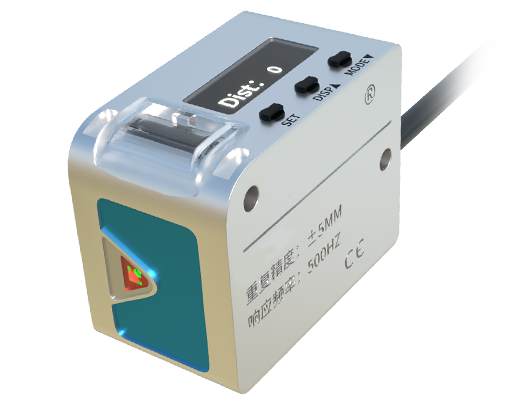
Despite their advantages, selecting the appropriate laser displacement sensor requires careful consideration of factors such as measurement range, sampling rate, and material properties. For instance, high-speed applications like vibration analysis demand sensors with kHz-level frequencies, while long-range measurements in warehouse automation may prioritize robustness over resolution. Industry standards, such as those set by ISO and IEC, provide guidelines for calibration and accuracy verification, ensuring consistency in performance.
Looking ahead, the integration of artificial intelligence and machine learning is poised to revolutionize sensor capabilities. AI-driven sensors can self-optimize parameters, identify anomalies in real-time, and adapt to varying production conditions without human intervention. This convergence of optics, electronics, and data science underscores the transformative potential of laser displacement monitoring in driving Industry 4.0 initiatives, where precision, efficiency, and reliability are paramount. As industries continue to evolve, these sensors will play a critical role in enabling smart manufacturing and sustainable operational practices.
