In the realm of industrial automation, metrology, and quality control, achieving micron-level precision at high speeds is a constant challenge. High-frequency laser displacement sensors have emerged as a cornerstone technology, enabling non-contact, rapid, and accurate measurement of position, thickness, vibration, and profile. Unlike conventional contact probes or slower optical systems, these sensors leverage advanced triangulation or time-of-flight principles to deliver data at rates often exceeding 100 kHz, making them indispensable for dynamic processes.
The core operating principle for most high-precision, high-frequency models is laser triangulation. A focused laser beam is projected onto the target surface. The diffusely reflected light is collected by a high-speed receiving lens and imaged onto a position-sensitive detector, typically a CMOS or CCD array. Any change in the target's distance causes a proportional shift of the light spot on the detector. Sophisticated onboard processors calculate this displacement in real-time. The "high-frequency" capability is achieved through ultra-fast detectors and optimized signal processing algorithms that minimize latency and allow for capturing rapid changes or vibrations.
For long-range applications, time-of-flight (ToF) principles are employed, where the sensor measures the phase shift or direct flight time of a modulated laser pulse. While traditionally offering slightly lower resolution than triangulation, modern high-frequency ToF sensors provide excellent performance for larger distances and high-speed applications like vehicle detection or bulk level monitoring.
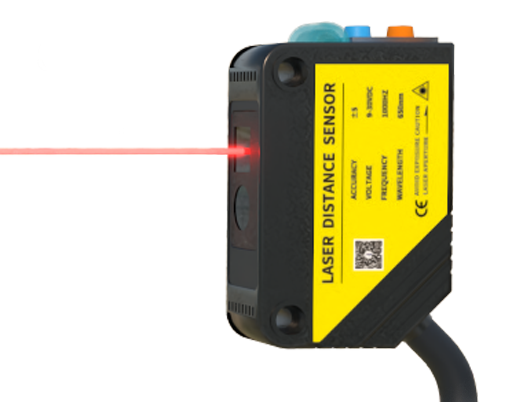
The advantages of integrating high-frequency laser displacement sensors into industrial systems are profound. First and foremost is speed. With sampling rates from 10 kHz to over 200 kHz, they can monitor fast-moving production lines, such as wire extrusion, vibrating components, or rotating parts, without aliasing. Second is precision. Resolutions down to 0.1 µm are achievable, ensuring even the smallest defect or deviation is detected. The non-contact nature eliminates mechanical wear, avoids deformation of soft materials, and allows measurement of hot, fragile, or sterile objects. Furthermore, their compact, robust housings, often rated IP67 or higher, make them suitable for harsh factory environments with dust, coolant, or vibration.
Applications span virtually every manufacturing sector. In electronics, they measure solder paste thickness, component coplanarity, and PCB warpage. In automotive, they are used for brake disc thickness monitoring, piston vibration analysis, and gap/flush measurement on assemblies. In metal processing, they control roller gaps in steel mills and measure vibration on machinery for predictive maintenance. In pharmaceutical and packaging, they verify fill levels, tablet thickness, and seal integrity at high line speeds.

Selecting the appropriate high-frequency laser displacement sensor requires careful consideration of several parameters. Key specifications include:
* Sampling Rate: Must be significantly higher than the frequency of the phenomenon being measured (Nyquist criterion).
* Spot Size & Optical Resolution: A smaller spot allows measurement of finer details but requires a more precise setup.
* Measuring Range & Stand-off Distance: The permissible distance window between the sensor and target.
* Linearity: The accuracy deviation across the entire measuring range.
* Material & Surface Dependency: Performance can vary with surface color, reflectivity, texture, and transparency. Models with automatic gain control or specialized optics for challenging surfaces (e.g., shiny metals, black rubber) are available.
* Output Interface: High-speed analog voltage/current, digital (USB, EtherCAT), or serial communication must match the data acquisition system.
Integration challenges often involve environmental factors. Ambient light, particularly from other lasers or strong IR sources, can interfere. Dust or steam in the optical path may scatter the beam. For highly reflective or transparent materials, using a diffuse reflection model, applying a developer spray, or selecting a sensor with a coaxial optical design (where the laser path and receiver are aligned) can mitigate issues. Proper mechanical mounting to minimize sensor vibration is also critical for achieving specified accuracy.
The future of this technology points toward even higher speeds, smarter sensors, and enhanced connectivity. Integration of AI chips for edge computing will allow sensors to perform preliminary data analysis, like outlier detection or trend prediction, directly at the measurement point. The adoption of multi-point laser line sensors, which capture an entire profile at high frequency, is growing for 3D inspection tasks. Furthermore, seamless integration into Industry 4.0 frameworks via OPC UA or MQTT protocols will make real-time measurement data more accessible for holistic process optimization.
In conclusion, high-frequency laser displacement sensors are a critical enabler of modern precision manufacturing and research. By providing a reliable stream of high-speed, non-contact dimensional data, they empower engineers to control processes with unprecedented accuracy, improve product quality, reduce waste, and transition toward data-driven, intelligent production systems. Understanding their principles and selection criteria is essential for leveraging their full potential in demanding measurement applications.