In the realm of industrial automation, the synergy between motor control systems and laser sensors represents a pinnacle of precision engineering. This integration is fundamental to achieving the high-speed, accurate, and reliable operations demanded by modern manufacturing, robotics, and material handling applications. At its core, motor control involves the precise regulation of a motor's speed, torque, and position. When augmented with the non-contact, high-resolution measurement capabilities of laser sensors, the potential for system optimization expands dramatically.
Laser sensors, particularly laser displacement sensors and laser micrometers, operate on the principle of triangulation or time-of-flight. They emit a focused beam of light onto a target surface and analyze the reflected signal to determine distance, position, or profile with micron-level accuracy. This real-time data becomes the critical feedback for closed-loop motor control systems. For instance, in a CNC machining center, a laser sensor can continuously measure the position of a cutting tool or the workpiece. This measurement is fed back to the servo motor controller, which instantly adjusts the motor's rotational angle or linear position to compensate for any thermal drift, mechanical wear, or vibration, thereby maintaining machining tolerances that are often finer than a human hair.
The advantages of integrating laser sensors into motor control loops are manifold. First and foremost is enhanced precision. Motors alone, even high-performance servos, operate based on internal encoders that measure shaft rotation. However, they cannot account for downstream mechanical inaccuracies like belt slippage, gear backlash, or lead screw wear. A laser sensor measures the *actual* output—the position of the end-effector or the product itself—providing true position feedback and enabling sub-micron corrective actions. Secondly, this integration significantly boosts system reliability and reduces downtime. Predictive maintenance becomes feasible as laser sensors can detect anomalous vibrations in a motor shaft or misalignment in a conveyor system long before a catastrophic failure occurs, triggering preventative alerts.
Furthermore, the combination enables advanced functionalities such as adaptive control. In complex robotic pick-and-place operations, the exact position and orientation of components may vary. A vision system guided by laser profiling can identify these variations, and the motion controller can dynamically recalculate the robot arm's trajectory in real-time, commanding the motors to follow a new, optimal path. This flexibility is crucial for agile manufacturing lines that handle high-mix, low-volume production.
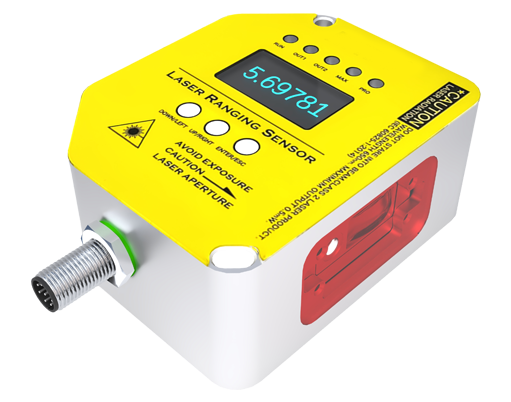
Key considerations for engineers implementing such systems include sensor selection, environmental factors, and communication protocols. The choice of laser sensor—its resolution, sampling rate, and working distance—must align with the motor's performance characteristics and the application's required precision. Environmental challenges like ambient light, dust, oil mist, or highly reflective target surfaces can interfere with laser signals. Selecting sensors with robust filters, specialized optics, or protective housings is essential. Seamless integration hinges on communication. Modern laser sensors and motor drives increasingly support high-speed industrial Ethernet protocols like EtherCAT, PROFINET, or EtherNet/IP. This allows for the deterministic, low-latency transfer of measurement data directly into the motion controller, creating a tightly synchronized and responsive control loop.
Looking ahead, the convergence of motor control and laser sensing is being propelled by trends like Industrial IoT (IIoT) and edge computing. Sensor data, combined with motor current and temperature telemetry, can be aggregated at the edge for sophisticated analytics, enabling deeper insights into overall equipment effectiveness (OEE) and process optimization. Additionally, advancements in sensor technology, such as the development of multi-point laser scanners and integrated sensor-controller units, are simplifying system architecture and lowering integration barriers.
In conclusion, the marriage of precise motor control with accurate laser sensing is not merely an incremental improvement but a transformative approach for industrial automation. It moves control systems from relying on assumed mechanical perfection to operating on verified, real-world feedback. This paradigm shift is essential for building the smart, adaptable, and ultra-efficient factories of the future, where the seamless dialogue between motion and measurement drives unparalleled levels of quality, productivity, and innovation.