In industrial automation and control systems, proximity sensors play a critical role in detecting the presence or absence of objects without physical contact. Among the various types, inductive and capacitive proximity sensors are two of the most widely used technologies. This article delves into their operating principles, highlighting key differences and typical applications.
Inductive proximity sensors are designed to detect metallic objects. Their operation is based on the principle of electromagnetic induction. The sensor contains an oscillator circuit that generates a high-frequency electromagnetic field around its active face. When a metallic object enters this field, eddy currents are induced on the surface of the object. These eddy currents draw energy from the oscillator, causing a reduction in oscillation amplitude. The sensor's detection circuit monitors this change and triggers an output signal when the amplitude drops below a predetermined threshold. The sensing range depends on factors such as the type of metal, object size, and sensor design. Ferrous metals like iron and steel typically offer longer detection distances compared to non-ferrous metals like aluminum or copper due to their higher magnetic permeability. Inductive sensors are immune to non-metallic materials like plastics, wood, or liquids, making them ideal for harsh industrial environments where dust, oil, or moisture is present. Common applications include position sensing of metal parts, speed monitoring of rotating gears, and end-of-travel detection in machinery.
Capacitive proximity sensors, on the other hand, can detect both metallic and non-metallic objects, including liquids, powders, and plastics. They operate on the principle of capacitance change. The sensor consists of an electrode that forms one plate of a capacitor, with the target object acting as the other plate. The surrounding environment serves as the dielectric medium. An internal oscillator generates an electrostatic field around the active face. When an object enters this field, it alters the dielectric constant and increases the capacitance between the electrode and the object. This change in capacitance affects the oscillator's amplitude or frequency. The sensor's circuitry detects this variation and switches the output state accordingly. The sensing range is influenced by the object's material properties, size, and dielectric constant. Materials with high dielectric constants, such as water or metals, are easier to detect than those with low dielectric constants like dry wood or air. Capacitive sensors often feature sensitivity adjustments to compensate for different materials or to ignore background interference. They are commonly used in level detection for liquids or granular materials, presence sensing of non-metallic containers, and touch-sensitive controls.
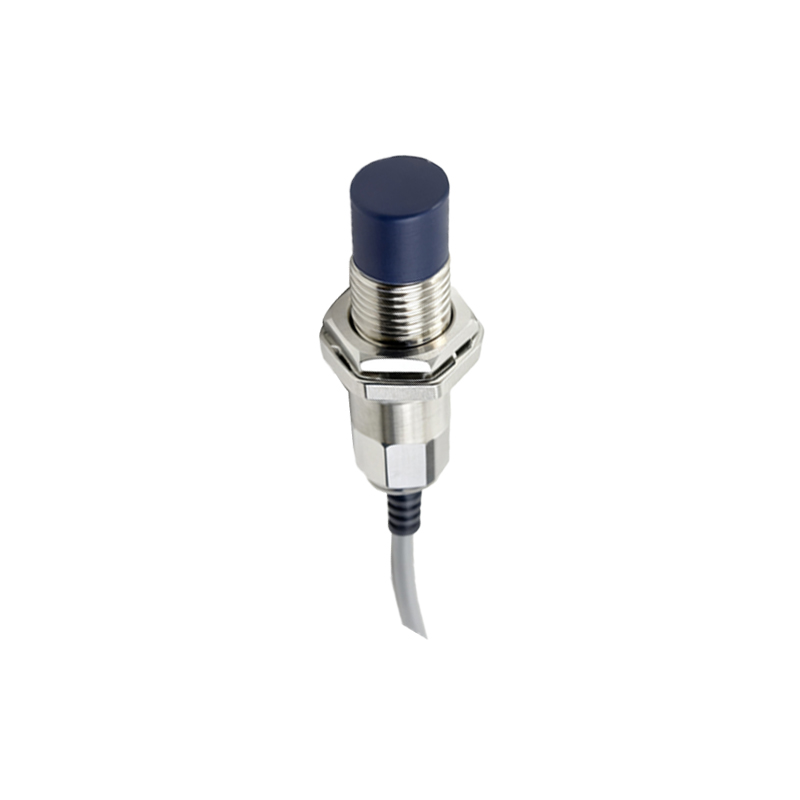
While both sensors provide non-contact detection, their selection depends on the application requirements. Inductive sensors excel in metal detection with high repeatability and resistance to environmental factors, but they cannot sense non-metallic objects. Capacitive sensors offer greater versatility in material detection but may be affected by humidity, temperature, or contamination. Understanding these principles helps engineers choose the right sensor for optimal system performance, ensuring reliability and efficiency in automated processes.