In the realm of industrial automation and control systems, proximity sensor transducers are indispensable components. They detect the presence or absence of an object within a specified range without physical contact, converting this detection into an electrical signal. This article delves into the various types of proximity sensor transducers, their operating principles, and typical applications, providing a comprehensive overview for engineers and technicians.
The fundamental principle behind proximity sensors is based on changes in an electromagnetic field, acoustic wave, or light beam. When a target object enters the sensor's field, it alters the field's properties, which the sensor detects and converts into a usable output signal, typically a switch closure or a change in voltage/current. This non-contact operation eliminates mechanical wear, enhances reliability, and allows for high-speed detection.
Several primary types of proximity sensor transducers are prevalent in industry:
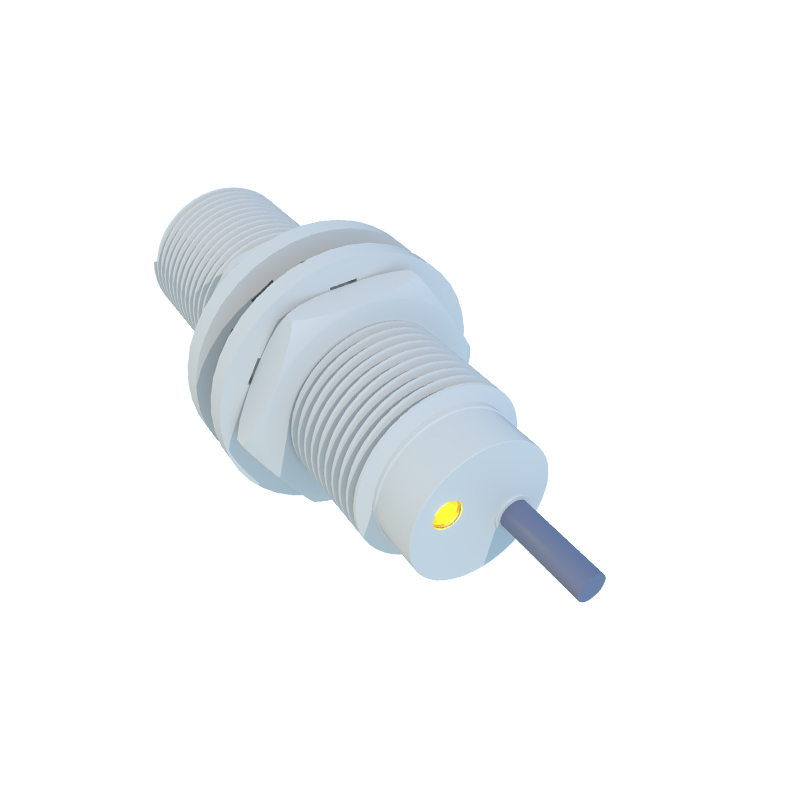
1. Inductive Proximity Sensors: These sensors generate an oscillating electromagnetic field. When a metallic object (ferrous or non-ferrous) enters this field, it induces eddy currents, causing a change in the oscillation amplitude. This change is detected and triggers the output. Inductive sensors are ideal for detecting metals and are widely used in machine tools, automotive assembly, and material handling for tasks like part counting, position verification, and limit switching. They are robust, resistant to environmental contaminants like dust and oil, but are ineffective for non-metallic materials.
2. Capacitive Proximity Sensors: Operating on the principle of capacitance change, these sensors can detect both metallic and non-metallic objects (plastics, wood, liquids, granules). The sensor forms one plate of a capacitor, the target object forms the other, and the air gap is the dielectric. As an object approaches, the capacitance increases, and once it reaches a threshold, the sensor switches. Common applications include level detection in tanks (for liquids or powders), material handling for non-metals, and presence detection of glass or plastic containers. They are sensitive to environmental factors like humidity and temperature.
3. Ultrasonic Proximity Sensors: These transducers emit high-frequency sound waves (ultrasonic) and evaluate the reflected echo. The time delay between emission and reception is used to calculate the distance to the object. They can detect virtually any material, regardless of color, transparency, or surface texture, and are excellent for measuring distance or presence in challenging environments. Applications include pallet detection, loop control, and liquid level sensing in harsh conditions with dust, steam, or smoke.
4. Photoelectric Sensors: While often categorized separately, they function as proximity devices. They consist of a light emitter (usually LED) and a receiver. When an object interrupts or reflects the light beam, the receiver detects the change. Types include through-beam (separate emitter and receiver), retro-reflective (uses a reflector), and diffuse (reflects light off the target itself). They offer long sensing ranges and can detect small objects. Applications are vast, including packaging, bottling lines, and object counting on conveyors.
5. Magnetic Proximity Sensors (Reed Switches/Hall Effect): These detect the presence of a permanent magnet. Reed switches use ferromagnetic reeds that close when a magnetic field is applied. Hall Effect sensors produce a voltage proportional to the magnetic field strength. They are used for detecting position in cylinders (piston position), door/window security systems, and speed sensing (e.g., counting gear teeth).
The choice of transducer depends on multiple factors: target material, required sensing distance, environmental conditions (temperature, contaminants), response speed, output type (PNP/NPN, analog, IO-Link), and installation constraints. Modern sensors often integrate advanced features like programmability, diagnostics, and network connectivity via protocols like PROFINET or EtherNet/IP.
In conclusion, proximity sensor transducers are critical for enabling precise, reliable, and maintenance-free automation. Understanding their distinct types and principles allows engineers to select the optimal sensor for a given application, ensuring system efficiency, safety, and productivity. Continuous advancements in miniaturization, sensing technology, and smart capabilities are further expanding their role in Industry 4.0 and the Industrial Internet of Things (IIoT).