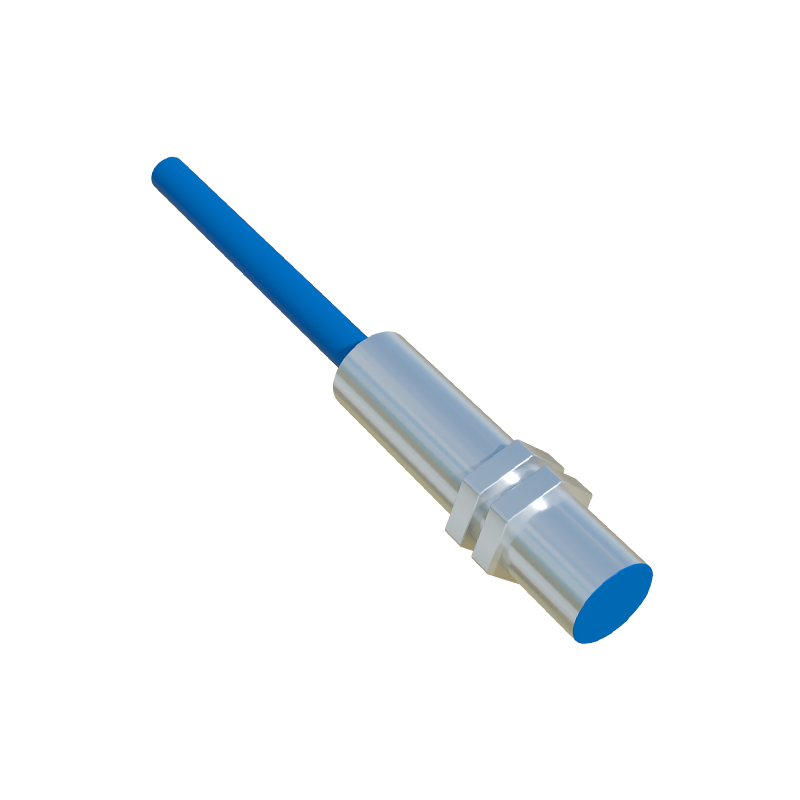
Proximity sensors are indispensable components in modern industrial automation, offering non-contact detection of objects within a specified distance. Their "sensing range" is a critical parameter that defines their operational sphere and directly impacts system design and reliability. This range, typically specified as the "nominal sensing distance (Sn)," is not a single fixed value but a complex characteristic influenced by sensor type, target material, environmental conditions, and installation specifics.
The core principle behind sensing range involves the generation of an electromagnetic field, ultrasonic waves, or a light beam. When a target object enters this field, it causes a detectable change—such as eddy current loss in inductive sensors, capacitance change in capacitive sensors, or reflection/attenuation in ultrasonic and photoelectric sensors. The maximum distance at which this change can be reliably detected by the sensor's electronics constitutes its effective sensing range.
Sensor technology dictates the fundamental range capabilities. Inductive proximity sensors, designed for detecting metallic objects, generally offer shorter ranges. Standard shielded (flush-mountable) sensors might have ranges from 1 to 15 mm, while unshielded (non-flush) types can extend up to 40 mm for ferrous metals and less for non-ferrous metals like aluminum or copper. Capacitive proximity sensors can detect both metallic and non-metallic materials (plastics, wood, liquids) and often provide slightly longer ranges, commonly from 3 mm to 40 mm, depending on the dielectric constant of the target material. Ultrasonic sensors operate on a time-of-flight principle and boast the longest ranges among standard proximity types, easily spanning from 30 mm up to several meters (e.g., 6m or 8m for many industrial models). Photoelectric sensors, while sometimes categorized separately, function as proximity devices in diffuse (reflective) mode. Their ranges vary widely; standard diffuse sensors may work from a few centimeters to 1-2 meters, while specialized long-range versions can detect objects tens of meters away.
It is crucial to understand that the nominal sensing distance (Sn) is defined under precise standard conditions: a defined target material (e.g., mild steel for inductive sensors), temperature of 23°C, and a specified supply voltage. Real-world application introduces factors that modify the effective range. The target material is paramount. For inductive sensors, the sensing range reduces significantly for non-ferrous metals—often to 30-50% of the Sn for steel. Capacitive sensor range increases with the target's dielectric constant. Target size and shape also matter; a target smaller than the sensor's sensing face or oddly shaped may not be detected at the full nominal range. Environmental conditions like extreme temperatures, humidity, dust, oil, or strong electromagnetic interference can attenuate the sensing field or cause signal drift, effectively reducing reliable range. Installation is another key factor. Mounting multiple sensors side-by-side can cause mutual interference (crosstalk), necessitating a minimum spacing, which effectively reduces the usable range in dense layouts. Flush-mounted shielded inductive sensors have a narrower, more focused field than non-flush types, which is beneficial for avoiding interference from surrounding metal but offers a shorter range.
Engineers must also consider the concept of assured operation. The "operating distance (Sr)" is the range within which the sensor is guaranteed to switch, accounting for all tolerances (supply voltage, temperature, manufacturing variances). It is typically 70% to 90% of Sn. The "reset distance" is the point where the sensor reliably turns off as the target moves away. Understanding hysteresis—the difference between the switch-on and switch-off points—is vital for stable control and preventing chatter.
Selecting the correct sensing range involves a careful balance. A sensor with excessive range for an application may detect unintended objects (like a machine frame or passing equipment), causing false triggers. Conversely, a sensor with insufficient range may fail to detect the target reliably, especially if there is mechanical vibration or misalignment. Best practice is to choose a sensor whose nominal range (Sn) is 1.5 to 2 times the required application distance. This provides a sufficient safety margin for tolerances, target variations, and minor misalignments, ensuring long-term, trouble-free operation.
In summary, the "useable range" of a proximity sensor is a dynamic value shaped by physics, technology, and application context. Successful implementation relies not on the catalog Sn value alone, but on a thorough understanding of the sensor's technology, the target's properties, and the installation environment. By accounting for these factors and incorporating an appropriate safety margin, engineers can leverage proximity sensors to build robust, precise, and reliable automated systems across countless industries, from precision assembly and packaging to heavy material handling and automotive manufacturing.